Skip to content
Nurses at the Magnet Conference

Magnet milestone luncheon, celebrating excellence together

Kaiser Permanente Vallejo proudly joined fellow Magnet-designated hospitals at an exclusive Kaiser Permanente luncheon, hosted by Janet Liang, during the 2024 Magnet Conference in New Orleans. As one of just two Magnet designated hospitals in Northern California, and part of the elite ten across 37 KP facilities statewide, Vallejo nurses shared their frontline perspectives on the Magnet journey, reflecting on the culture of excellence, teamwork, and transformational change that defines their commitment to nursing and patient care. 

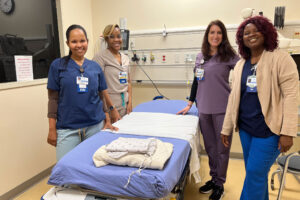
Nurse residents in the Sim Lab.

Training for real-life events 

The Nurse Residency Cohort 10 sharpened their critical thinking and response skills through hands-on training with the new SimMan during code blue and rapid response simulations. Immersed in realistic scenarios, these future leaders gained invaluable experience, preparing them to handle high-stakes situations with confidence and precision. Their training aims to positively impact rapid response effectiveness and code blue outcomes, enhancing patient safety and elevating care standards across the hospital.  

Participants (left to right): Leila Young, Mickaela Estep, Mac Abat, Marley Lester, and Angelie Soriano. 

Nurses in the CDA

Critical Decision Area a vital bridge of care

Established in early 2024, the Clinical Decision Area (CDA) was created to improve patient throughput and address the growing needs of the community.

Nurses in a patient room Marie Berrette, BSN, RN; Leslie Eze, FNP, MSN, RN; Valerie Canela, BSN, RN; and Lou Tra, BSN, RN (pictured) embody the collaborative efforts to optimize patient flow especially during high census challenges.

With structured workflows and targeted discharges, the CDA serves as a vital bridge—delivering timely care for patients requiring under 24-hour therapies while alleviating ED crowding and expediting inpatient admissions. 

Nurse Melanie Baccay in front of a poster

Nurse pioneers TIMERS wound care assessment framework

Melanie Baccay BSN, RN, PHN pioneers TIMERS wound assessment framework integration, highlighting the crucial intersection of clinical care and social determinants in wound healing. Her evidence-based approach transforms traditional wound care by incorporating social factors, setting new standards for comprehensive patient assessment. 

Patient in bed with oxygen mask on speaking to a nurse.

Nasogastric tube and BIPAP mask-related pressure injury in adult care services 

The Adult Services tackled the rising issue of medical device-related pressure injuries with a targeted project focusing on nasogastric tubes and BiPAP masks. Despite a reduction in nasogastric tube injuries from 2022 to 2023, BiPAP-related injuries doubled, signaling the urgent need for standardized guidelines and collaborative interventions. The initiative is spearheaded by the Inpatient Wound/Ostomy Department team — Raisa Pangilinan, BSN, RN CWON, Lindsay Fletcher BSN, RN CWON, Dawn Davis Clinical Wound Associate under the leadership of Charity Shelton DNP, RN, NE-BC.  

Led by wound-certified nurses, the initiative united nursing leadership, respiratory therapists, and shared governance councils. For nasogastric tubes, the team introduced the “CLEAN” framework: correct tube positioning, stabilize tube, evaluate area under/tube, alleviate pressure, and note date and time. This evidence-based approach became the cornerstone of updated workflows. Medical-surgical staff received hands-on training to ensure adherence during annual skill days. 

In BiPAP care, challenges like opaque foam padding that obscured skin assessments were addressed with a clear gel barrier, selected after collaborative trials with respiratory therapy. This change allowed for real-time skin evaluations while maintaining patient comfort. A new standardized workflow defined the roles of respiratory therapists and nurses, ensuring seamless communication and accountability. 

By mid-2024, the project achieved zero pressure injuries for both devices, highlighting the success of interdisciplinary collaboration and evidence-based interventions. With plans to expand regionally, this initiative demonstrates how targeted strategies, teamwork, and frontline engagement can drive sustainable improvements in patient safety and care quality, setting a higher standard for device-related injury prevention. 

Poster of HAPI Device project.
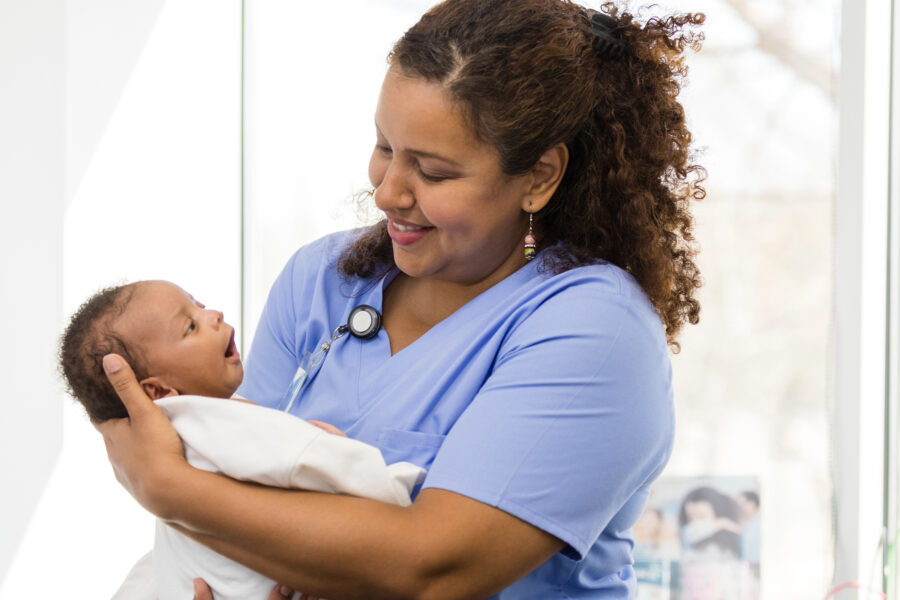
Nurse holding a newborn

Project aims to increase exclusive breastfeeding rate at hospital discharge   

In 2024, Keshni Lal, DNP, RN, SNIV spearheaded a quality improvement project aimed at enhancing exclusive breastfeeding (EBF) rates at hospital discharge within the Family Birth Center. Focused on implementing uninterrupted skin-to-skin contact (SSC) within the first hour of life post-cesarean delivery, the initiative addressed a significant practice gap affecting breastfeeding outcomes.  

Guided by the Plan-Do-Study-Act (PDSA) paradigm, Keshni collaborated with an interdisciplinary team of pediatricians, anesthesiologists, lactation consultants, and nurses to develop comprehensive training and workflows. This included pre- and post-tests, mock OR simulations, and live workflow sessions. By ensuring mothers and infants bonded immediately after delivery, the project fostered early breastfeeding success and maternal confidence.  

The project achieved an impressive 85% EBF rate at discharge, surpassing the initial goal of 80%. Furthermore, 100% of eligible mothers and infants experienced SSC in the operating room. These outcomes highlighted the critical role of SSC in supporting breastfeeding success and fostering healthier communities. By prioritizing uninterrupted SSC and deferring non-essential care, the project demonstrated how early bonding supports natural newborn behaviors and long-term breastfeeding success. 

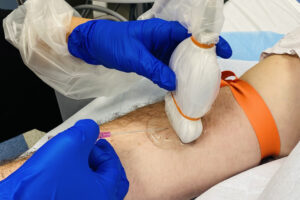
A nurse using ultrasound

Emergency department innovation: Breaking barriers with Ultrasound-Guided IV Access  

The Ultrasound-Guided Intravenous (USGIV) Access Program, a nurse-driven initiative in the Emergency Department (ED), has revolutionized care for hard-stick patients by reducing delays in treatment and improving patient satisfaction. Previously, only 14% of ED nurses were trained in USGIV access, leading to multiple unsuccessful attempts that delayed care and caused discomfort for patients. Research shows that USGIV training significantly decreases delays while boosting satisfaction—a challenge embraced by the ED team. 

Probe cover over the machineThis innovative program is the brainchild of Marta Suarez, BSN, RN, and Vanessa Alvillar, BSN, RN, who collaborated with Jonathan Chen, MD, Supervisor of Medicine, and Ruben Quitoriano, BSN, RN, Clinical Nurse Educator, ANM, to bring it to life. Their goals included training ED nurses in USGIV, standardizing the practice with evidence-based guidelines, implementing a department-wide policy, and ensuring proper supplies for safe and effective IV placement. 

Since its inception, 15 ED nurses have been trained, with plans to expand the program in 2025. A comprehensive policy now guides the practice, ensuring safe and consistent application. All USGIV-performing nurses have been signed off following rigorous training, and they assist during night shifts when the Recuperative Skills team is unavailable. Nurses with prior experience were also proctored and signed off, expanding the pool of super-users in the department. Additionally, new supplies, including a variety of catheters and sterile covers, have enhanced safety and efficiency. 

Testimonials from nurses and patients underscore the program’s success. Patients express gratitude for fewer pokes and faster care, while nurses share how the skill has boosted their confidence and efficiency. “Many things in emergency care hinge on IV access. USGIV saves time, reduces patient discomfort, and prevents delays,” shared Josh, ED RN. 

Garden dedication plaque

Research: Finding the third space through gardening

Research: Finding the third Space through gardening: strengthening relationship mutuality and lowering stress in the caregiver and care recipient who has a disabling injury or illness through gardening 

Authors:  

  • Samantha P. Avecilla, MSN, CRRN, CNL 
  • Katelynn Campbell, CTRS, RTC 
  • Michelle Camicia, PhD, RN, CRRN, FARN, FAAN 
  • Anita Catlin, PhD, FNP, CNL, FAAN 

Abstract: 

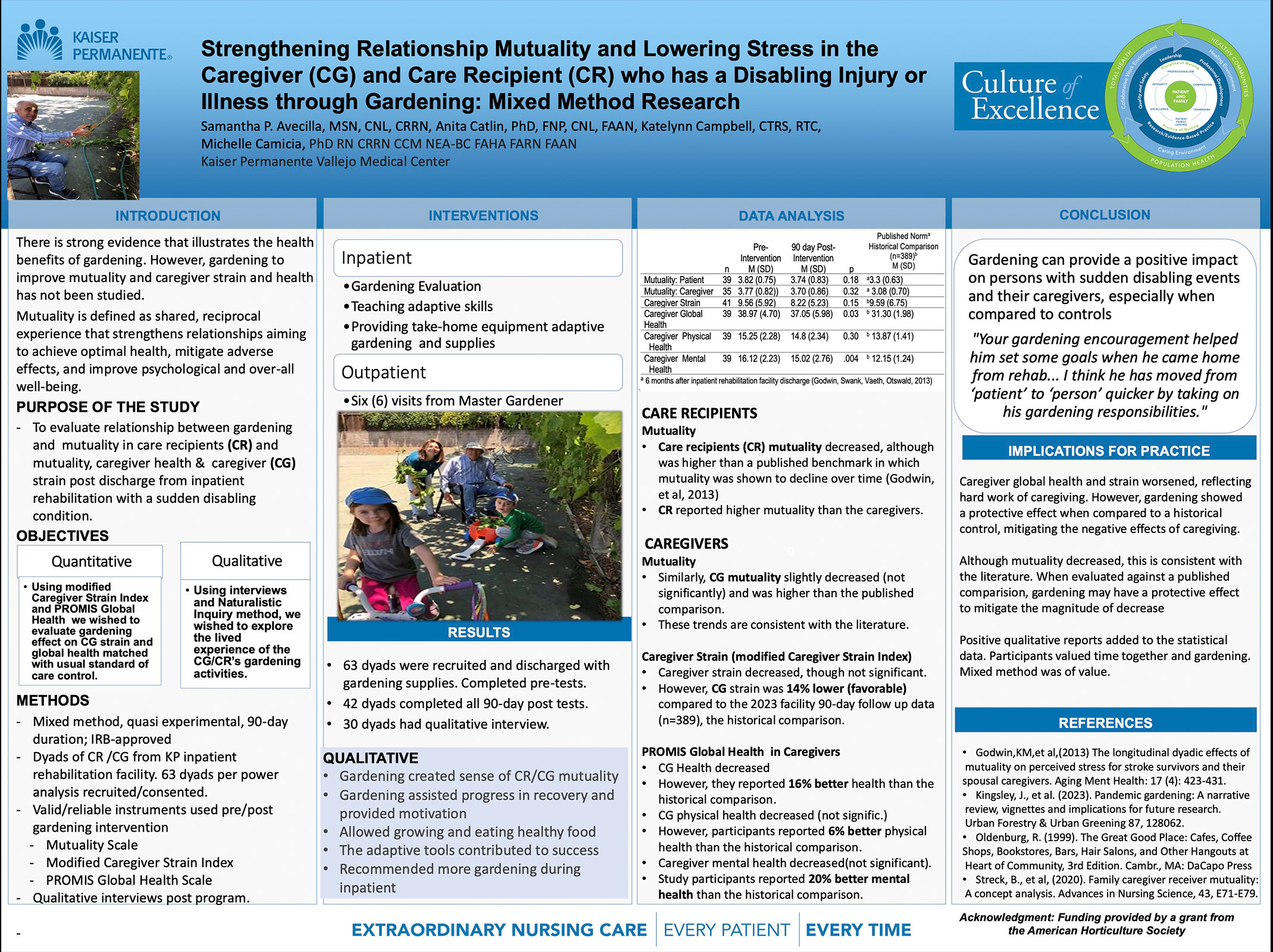
Caregivers of patients who experience a disabling condition often experience adverse health effects as a result of their caregiver role. Further, decreasing mutuality in the caregiver/care recipient dyadic relationship has been reported across the trajectory of caregiving. There is strong evidence that illustrates the health benefits of gardening. However, gardening to improve mutuality & caregiver strain and health has not been studied. The purpose of this study is to evaluate the relationship between gardening and mutuality in care recipients (CR) and mutuality, health & strain in the caregiver (CG) post discharge home from an inpatient rehabilitation facility. Participants included patients with a sudden disabling condition and their family caregivers who participated in a gardening intervention and were compared to a cohort of CGs who received usual care and with published benchmarks. A qualitative component of the study explored the lived experience of the CG/CR’s gardening activities. The intersection of quantitative and qualitative findings was evaluated. The pre-post quantitative results revealed 1) CR mutuality decreased, though was higher than a published benchmark, 2) CG mutuality was higher than the published comparison, 3) the CR reported higher mutuality than the caregivers, 4) caregiver strain was 14% lower (favorable) compared to the 2023 annualized facility 90-day follow up data (historical comparison) 5) CG health decreased, though study participants reported 16% better health than the historical comparison, 6) study participants reported 6% better physical health than the historical comparison, and 7) study participants reported 20% better mental health than the historical comparison. The qualitative themes revealed that 1) gardening activities created a sense of CR/CG mutuality, 2) assisted in the recovery process, and provided motivation, 3) allowed growing/eating healthy food, and 4) adaptive tools contributed to success. The quantitative findings intersected with the qualitative findings which revealed gardening provided a positive impact on persons with sudden disabling events and their caregivers. 

A poster of the study by nurses about gardening.

The Good Catch  

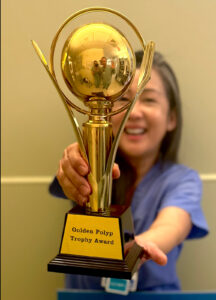
Catherine Hernandez with an award.The Good Catch Initiative is an innovative program spearheaded by Catherine Hernandez BSN, RN, CEN, pictured at left, of Gastroenterology/Special Procedures. This initiative emphasizes prevention and safety within the workplace. It identifies and addresses potential hazards that could harm patients, staff, or equipment before they result in incidents. Through timely interventions and corrective actions, staff ensure that risks are mitigated, and safety is maintained. 

A “Good Catch” refers to situations where incidents are avoided through proactive intervention, while a “Near Miss” describes events that can cause harm but fortunately did not. Notable examples of Good Catches in the department include the prevention of $14,000 worth of GI equipment damage when a nurse identified improper handling of a scope before it was accidentally processed. This incident was reviewed and addressed during staff huddles and educational sessions as a critical reminder. Another significant Good Catch involved identifying and replacing four hospital wheelchairs with missing rubber protectors, effectively preventing potential injuries and ensuring patient safety.  

One of the most impactful aspects of the program is its ability to close the loop on Good Catch reports, ensuring frontline staff see tangible actions taken because of their vigilance. This encourages further reporting and recognizes staff as proactive agents of safety and action. To motivate participation, the initiative incentivizes staff with awards such as the Golden Polyp Trophy and culminates in the prestigious “The Greatest Catch of the Year” trophy for the most outstanding safety intervention.  

Plans are underway to expand the Good Catch Initiative hospital-wide in collaboration with the Risk Department, promoting a unified culture of prevention and safety in the workplace. As Catherine repeatedly states, “Prevention is our intention.” 

Group of Vallejo PACU nurses

Enhancing efficiency with the Fast Track Process in Perioperative Care  

In 2024, Kaiser Permanente Vallejo Medical Center’s Perioperative Department launched the Phase 2 Project, a collaborative initiative aimed at improving efficiency and enhancing the patient experience in outpatient surgeries utilizing Local MAC or regional blocks. Through teamwork and innovation, this project focused on reducing the length of stay (LOS) in post-anesthesia care units (PACUs), achieving remarkable results. The team is led by Peggy Shen, RN SNIII, Roy Domingo BSN, RN, SNIII, Grace Prado-De Leon, BSN, RN SNIII, Laurence Borja, RN, Adriana Torres MSN, RN, CCRN, CNL, CPAN – PACU ANM, Emily S. Velicaria BSN, RN, CNOR – OR ANM, Kathleen Rose Littlepage, MSN/MBA(c), BSN, RN – PACU/Recovery Manager and Jonathan Khersonsky, MD – Anesthesiologist) 

The process was developed through close collaboration among pre-op nurses, anesthesia teams, PACU staff, and leadership to streamline workflows and improve communication. Patients meeting specific criteria for Phase 2 care could move directly to the discharge zone, bypassing unnecessary steps while ensuring safety. The initiative also introduced tools like PASS scores to assess patient readiness, ensuring only those fully prepared were fast-tracked. This approach reduced the average length of stay from 87 minutes to 61 minutes, aligning with national benchmarks recommended by the Journal of Peri Anesthesia Nursing Best Practices and Kaiser Permanente’s regional standards of 60–90 minutes. 

Key to this success was the communication and in lockstep within the perioperative team, where each role—from pre-op to PACU—was integral to identifying eligible patients and maintaining seamless transitions. The Fast Track Process excluded cases involving general anesthesia or complex needs to prioritize patient safety and maintain high standards of care. 

Looking ahead, patient feedback collected during post-op calls will further refine the process, gauging satisfaction with discharge timelines and ensuring the approach meets patient needs. This aligns with previous successful initiatives like the Lap Chole project, reinforcing the department’s commitment to continuous improvement. 

Back To Top