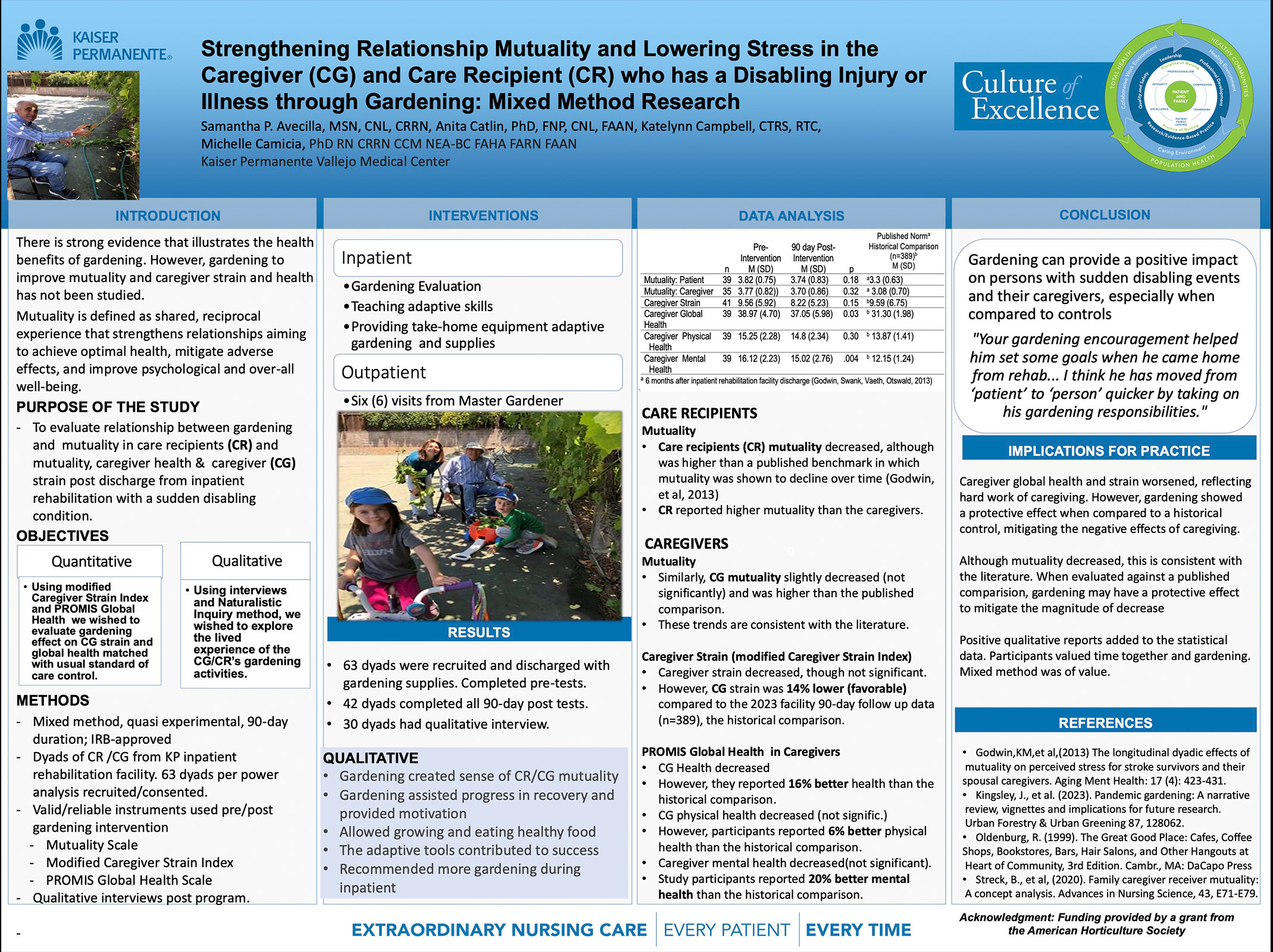
Research: Finding the third Space through gardening: strengthening relationship mutuality and lowering stress in the caregiver and care recipient who has a disabling injury or illness through gardening
Authors:
- Samantha P. Avecilla, MSN, CRRN, CNL
- Katelynn Campbell, CTRS, RTC
- Michelle Camicia, PhD, RN, CRRN, FARN, FAAN
- Anita Catlin, PhD, FNP, CNL, FAAN
Abstract:
Caregivers of patients who experience a disabling condition often experience adverse health effects as a result of their caregiver role. Further, decreasing mutuality in the caregiver/care recipient dyadic relationship has been reported across the trajectory of caregiving. There is strong evidence that illustrates the health benefits of gardening. However, gardening to improve mutuality & caregiver strain and health has not been studied. The purpose of this study is to evaluate the relationship between gardening and mutuality in care recipients (CR) and mutuality, health & strain in the caregiver (CG) post discharge home from an inpatient rehabilitation facility. Participants included patients with a sudden disabling condition and their family caregivers who participated in a gardening intervention and were compared to a cohort of CGs who received usual care and with published benchmarks. A qualitative component of the study explored the lived experience of the CG/CR’s gardening activities. The intersection of quantitative and qualitative findings was evaluated. The pre-post quantitative results revealed 1) CR mutuality decreased, though was higher than a published benchmark, 2) CG mutuality was higher than the published comparison, 3) the CR reported higher mutuality than the caregivers, 4) caregiver strain was 14% lower (favorable) compared to the 2023 annualized facility 90-day follow up data (historical comparison) 5) CG health decreased, though study participants reported 16% better health than the historical comparison, 6) study participants reported 6% better physical health than the historical comparison, and 7) study participants reported 20% better mental health than the historical comparison. The qualitative themes revealed that 1) gardening activities created a sense of CR/CG mutuality, 2) assisted in the recovery process, and provided motivation, 3) allowed growing/eating healthy food, and 4) adaptive tools contributed to success. The quantitative findings intersected with the qualitative findings which revealed gardening provided a positive impact on persons with sudden disabling events and their caregivers.