
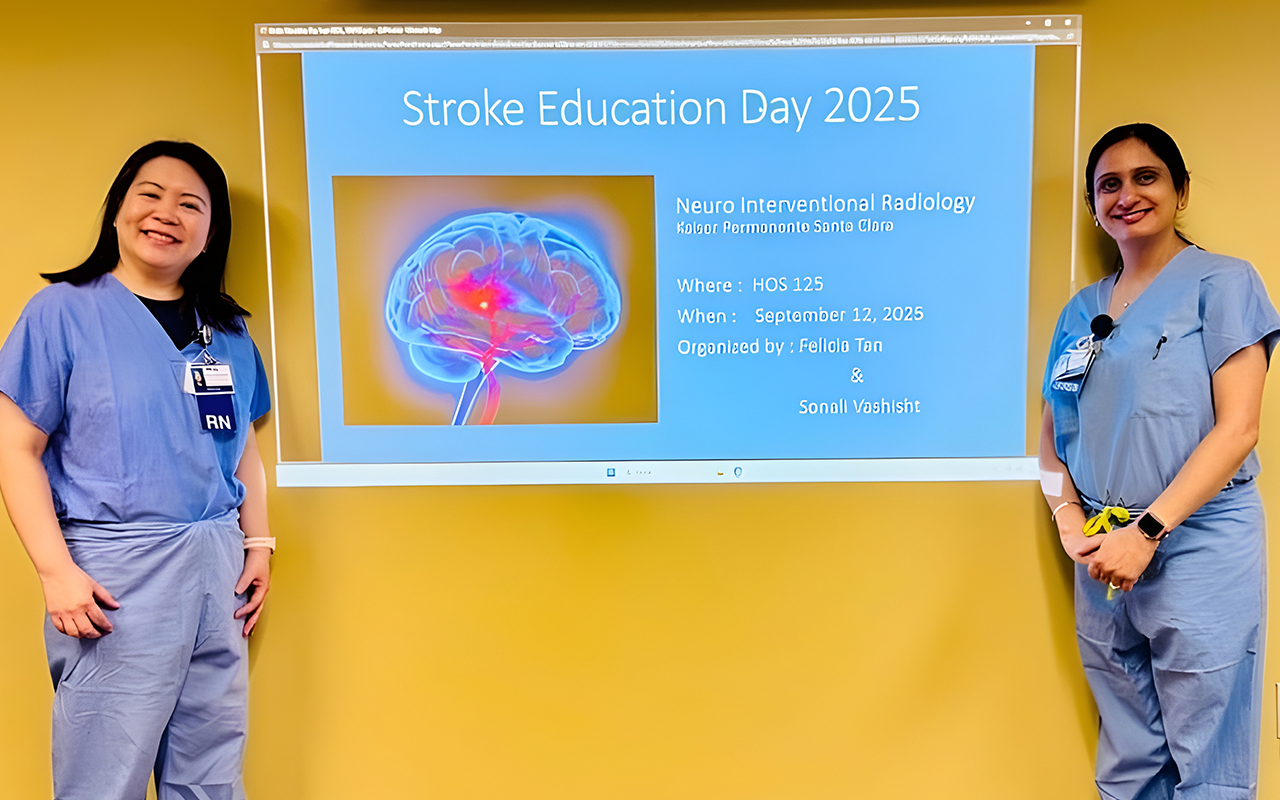
Kaiser Permanente Santa Clara (KP SCL) is advancing stroke care through the Endovascular Stroke Treatment (EST) Performance Improvement and Timing Project, led by Interventional Radiology (IR) nurses Sonali Vashisht, BSN, RN, CRN and Felicia Tan, MBA, BSN, BBA, RN with support from IR nurse manager Feliciano Javier, BSN, RN. This initiative addresses critical gaps in efficiency, quality, and timeliness for patients requiring EST from Emergency Department (ED) arrival to Neuro Interventional Radiology (NIR) procedure start.
Guided by the ADDIE (analysis, design, development, implementation, evaluation) model, the project provides a structured framework for continuous improvement and effective learning. The primary goals include streamlining workflows between ED and NIR, strengthening communication, and enhancing teamwork during patient transfers. Target participants include ED nurses and techs, NIR nurses and technologists, anesthesiologists, and neuro-interventional physicians.
The team began by observing real workflows and reviewing past EST cases to identify delays and coordination challenges. Learning objectives focus on efficient workflow practices, addressing communication breakdowns, and using tools such as checklists and chart chat to improve collaboration.
Interprofessional simulations between ED and NIR teams form the foundation of the instructional strategy. These sessions replicate stroke alerts and transfers, recording key milestones such as CT read, EST decision, NIR room readiness, and groin puncture to measure performance. Debriefing themes from simulations and real cases are collected to refine processes and enhance patient safety.
One of the key highlights of the initiative was a Stroke Education Day, held in September 2025. The event featured expert presentations by Khamidulla Bakhadirov, MD; Mark Mamlouk, MD; and Benjamin Pulli, MD. Additionally, Virginia Riggall, DNP, RN, led TeamSTEPPS training to strengthen collaboration. Hands-on simulation exercises further reinforced effective teamwork and communication across departments.
Early results are promising: average NIR door-to-groin time improved from 16.4 minutes in 2024 to 16.0 minutes in 2025 following simulation training. Next steps include expanding simulations to ICU and anesthesia teams, implementing learnings in real cases weekly, and continuing post-data collection for regional data outcomes.
By fostering collaboration and precision, KP SCL is setting a new standard for timely, high-quality stroke care.