
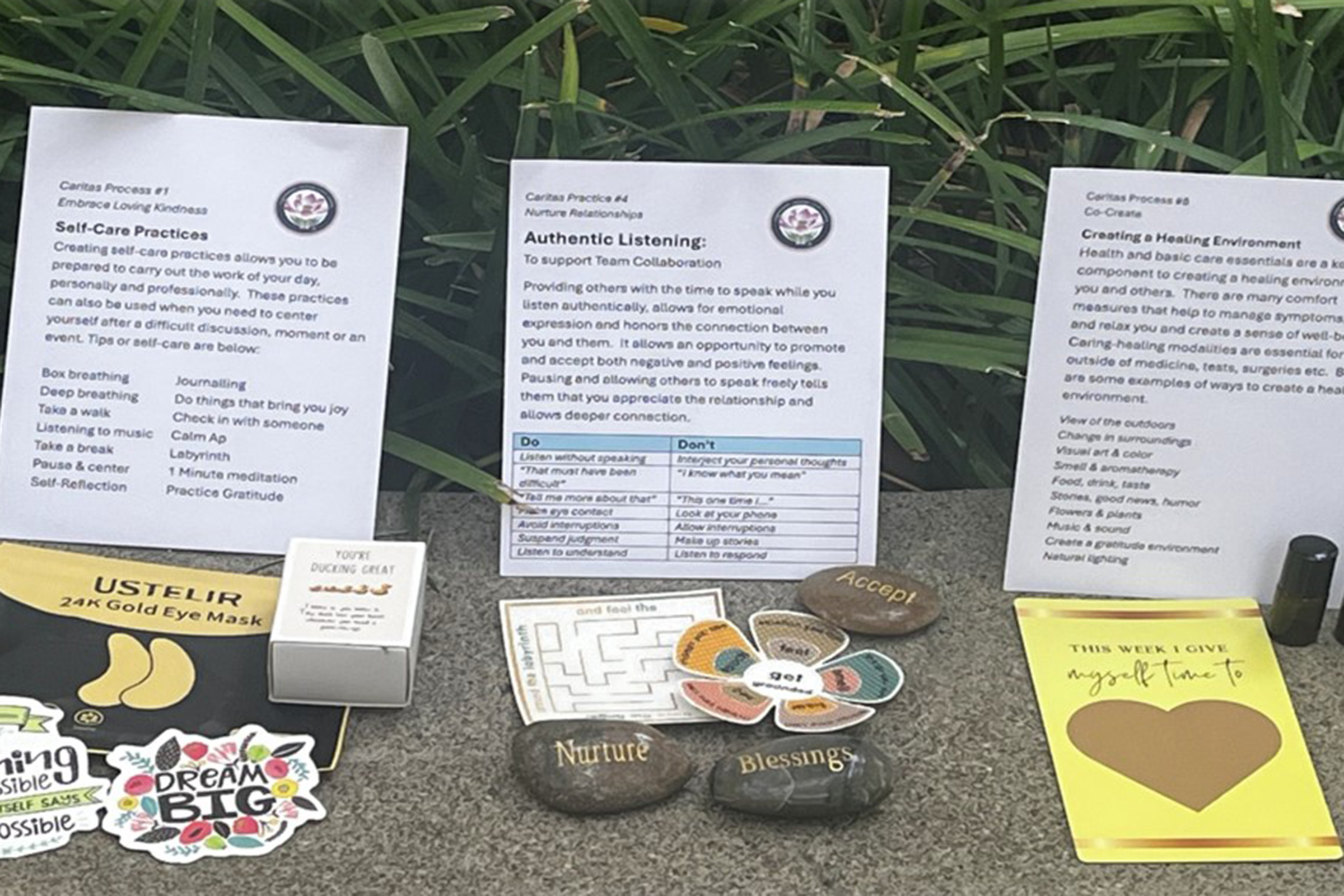
In today’s healthcare environment, leaders face constant change, complexity, and high emotional demands that test their ability to sustain resilience and compassion. At Kaiser Permanente Vacaville Medical Center, a Caritas Coach capstone project explored how micro‑resiliency practices—such as mindfulness, aromatherapy, and breathing exercises — can be integrated into leadership development to strengthen presence, collaboration, and well‑being. Guided by Cherie Stagg, DNP, RN, NEA‑BC, Jessica Flanagan, MBA, RD, CNSC, Fung Wan Iris Ng, MSN, RN, CCRN, and Melissa Gay, MSN, RN, MEDSURG‑BC, participants engaged in experiential learning and reflective dialogue during Daily Safety Briefings. These brief, intentional practices helped leaders sustain focus, adaptability, and compassion under pressure.
Grounded in caring science, the initiative emphasizes that caring is both a moral ideal and a transpersonal process requiring leaders to center themselves through reflective, mindful practices. As Jean Watson (2008) describes, caring science provides a framework for sustaining compassion and human connection amidst stress and complexity. By embedding caring science into leadership routines, organizations move beyond operational efficiency to cultivate trust, empathy, and collaboration across diverse teams.
Approximately 19 managers, directors, supervisors, and senior leaders participated in the six‑week pilot. A pre‑survey assessed baseline understanding of caring science and self‑care practices, followed by education on three Caritas processes: embracing loving‑kindness for self‑care, nurturing relationships for collaboration, and co‑creating healing environments. Post‑survey results demonstrated measurable gains across all processes, with the most significant improvement being a 35‑point increase in leaders’ confidence to build healing environments across hospital settings.
This initiative showed that embedding resiliency practices within the caring science framework not only strengthens individual coping skills but also reinforces a culture of safety, compassion, and healing. The results affirm caring science as a cornerstone of resilience, compassion, and collaborative leadership.