
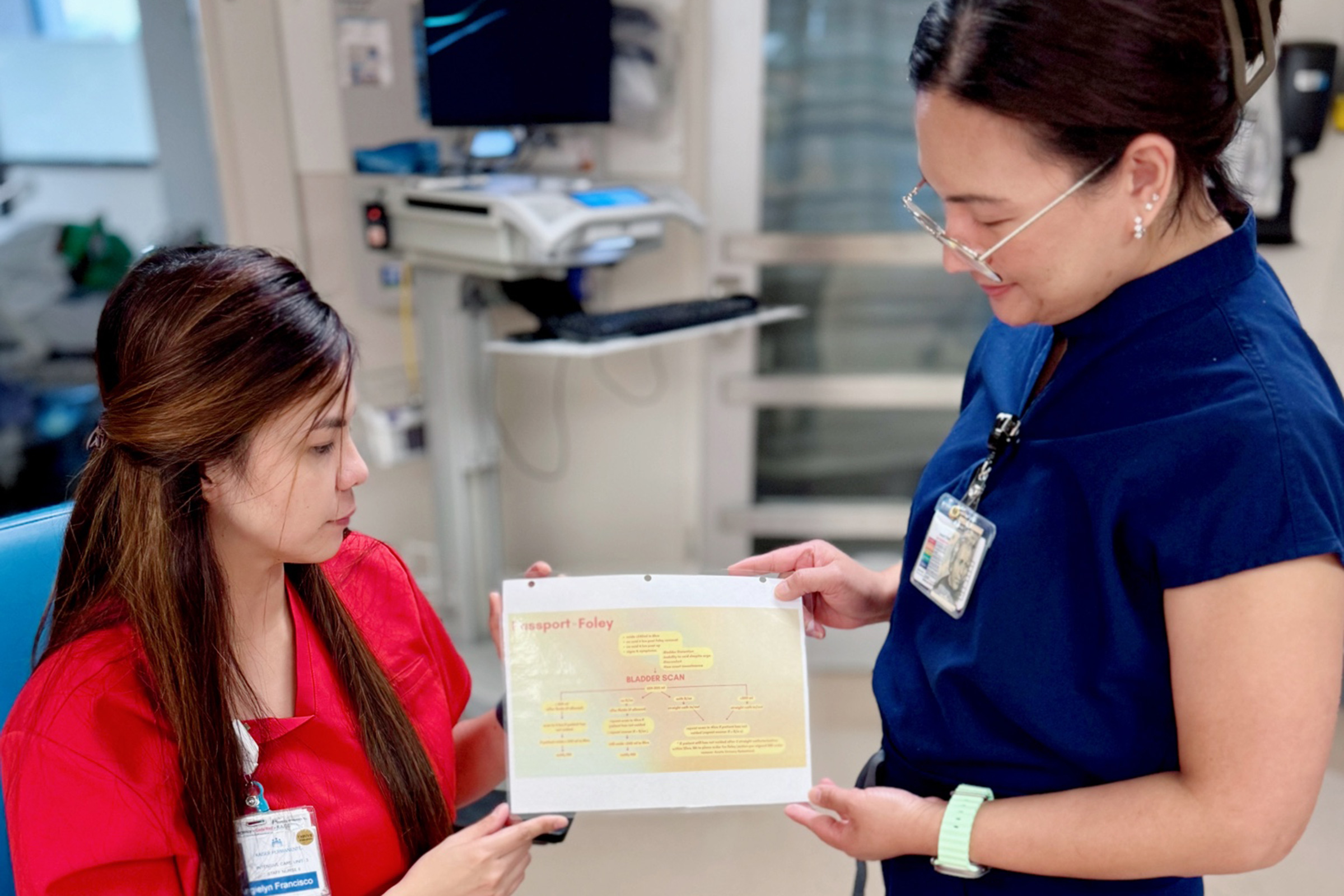
ICU nurses at Kaiser Permanente Sacramento Medical Center (KP SAC) demonstrated how frontline clinical insight and innovation can directly improve patient outcomes. In 2024, the unit continued to experience Catheter-Associated Urinary Tract Infections (CAUTIs) despite adherence to indwelling urinary catheter care bundles. At the same time, another contributing challenge became increasingly evident, urinary retention following Foley removal. Studies suggest that up to 30% of ICU patients experience urinary retention after an indwelling catheter is removed, often leading to reinsertion, prolonged catheter days, and an increased risk for CAUTI.
Although KP SAC uses a nurse-driven indwelling urinary catheter removal protocol, ICU nurses recognized that decisions related to urinary retention and potential reinsertion were often inconsistent. Nurses frequently faced uncertainty about how to proceed when a post-void residual was elevated or when a patient’s condition was unclear. Preventing unnecessary reinsertion became a critical priority, aligned with the overarching goal of minimizing indwelling urinary catheter use whenever possible.
A review of daily practice revealed that, while staff were knowledgeable about CAUTI prevention principles, variation existed in how nurses interpreted and applied the nurse-driven Foley removal protocol, particularly around post-void urinary retention. As one ICU nurse shared, “We realized our staff needed a clearer, quick, visual reference to guide decisions in real time. This saves us time and avoid inconsistent approach”
To address this gap, ICU clinical nurses Joyce Sandiko, BSN, RN, and Lou Angielyn Francisco, BSN, RN, developed a simple, evidence-informed decision tool to promote consistent practice and reduce unnecessary catheter use. The result was the “Passport to Foley” guide, a concise flowchart that walks bedside nurses through the assessment and management of urinary retention following Foley removal. The algorithm includes:
- Clear patient inclusion and exclusion criteria
- Step-by-step bladder scan guidance, including thresholds for urinary retention
- Decision points for next steps such as repeat scanning, encouraging voiding, or considering intermittent catheterization
- Criteria for when reinsertion is clinically indicated and when it is not
Following implementation, the unit noted a meaningful improvement in outcomes. CAUTI rates decreased from 2.07 per 1,000 catheter days in Q3 2023 and gradually decline to zero in Q1 and Q2 2025, demonstrating sustained improvements.
These results demonstrate how a simple, clarity-enhancing tool can optimize nurse-driven protocols, strengthen CAUTI prevention practices, and empower frontline nurses to apply evidence-based decision-making at the bedside.