Skip to content
Operations featured image placeholder

Nursing Professional Development Specialists gatekeepers of nursing practice 

Nursing Professional Development Specialists (NPDS) and Clinical Nurse Specialists (CNS) are the backbone of nursing excellence, driving professional growth, and fostering a culture of continuous learning. By guiding nurses to reach their full potential, the NPDS and CNS of the Kaiser Permanente Nursing Professional Development Department advances professional nursing and elevate the overall quality of patient care, creating a ripple effect of excellence throughout the hospital.

Nurse Transition programs

Professional development specialists are dedicated to nurturing the next generation of nurses. Students acquire real-world learning through placement in clinical facilities. In partnership with local Schools of Nursing, the hospital’s Nursing Professional Department facilitated over 50 student nurses to obtain hands-on training and other opportunities, such as senior preceptorship.

As a Kaiser Permanente NCAL Practice Transition Accreditation Program (PTAP) site, Sacramento Medical Center successfully transitioned 34 Nurse Residents across five cohorts into staff nurse roles thanks to the NPDS’s dedication to skill-building, preceptorship, and mentorship.

Two Sacramento Medical Center nurses proudly celebrated their successful transition from Med-Surg to Critical Care nursing practice. Both completed a six-month course of intensive training using modular education, instructor-led classes, equipment return demonstrations and simulation exercises.

Enhancing nursing practice

Nursing Professional Development Days (PDD) were restructured and offered monthly and featured gamification and hands-on scenario-based training. Facilitated by clinical nurses and NPDS, learning stations support peer-to-peer education, which allows staff to contribute and share their expertise. In 2024, about 130 staff members attended the PDD as part of their ongoing skills enhancement.

To enhance staff readiness when faced with clinical emergencies, NPDS and Clinical Nurse Specialists facilitated mock drills in various clinical units, including Code Blue, massive transfusion protocols, and stroke alert drills.

In 2024, the following in-services and classes were offered to the staff as part of their initial or ongoing continuing education.:

  • Tele and beyond: designed for Clinical Nurses in telemetry units that cater to chronic vents, infusion of cardiac drips, and SQ DKA protocol.
  • Neuro Care Nursing:
    • The Neuro Essentials class, offered to new staff in neuro units, covers care of neuro and spine surgeries, and equipment such as External Ventricular Drains and rapid EEG monitoring.
    • Stroke Classes: The Stoke 101, Annual Stoke Updates, and Annual Stroke Symposium are courses and continuing educational activities that focus on basic to advanced concepts in stroke care.
    • Rapid Response Team (RRT) and Code Class were offered to non-ICU nurses to enhance their confidence and skills in responding to an RRT call or Code Blue.
    • Continuous Renal Replacement Therapy (CRRT) is a quarterly course for ICU staff caring for patients who require CRRT.
  • After completing the American Organization of Nurse Leaders (AONL) competency for leaders, the NPDD restructured the quarterly PCS Day Away for nurse leaders tailored to address identified gaps in leadership competencies and integrate more interactive elements such as role-playing, presentations, and team-building activities.
  • Facilitating Change and Quality Improvement
  • Supported the department-specific recognition programs such as Beacon Award, Peri-op Go-Clear, and Surgical Safety- Retained Surgical Items by coordinating the gap analysis, project direction, data gathering, and exemplar writing.
  • Led staff training on initiatives, product roll-out, and new clinical programs in Sacramento, such as the automatic formalin machine and needle stick prevention plan, Robotics Integration in surgeries, and Deep Brain Stimulation surgery implementation.
Health and wellness caring science featured image placeholder

Kaiser Permanente brings free cataract surgeries to Sacramento’s uninsured 

For 28 years, Kaiser Permanente Sacramento Eye Surgery Center has championed access to life-changing care by participating in Mission Cataract USA. This program offers free cataract surgeries to non-members/uninsured individuals who qualify and cannot afford the procedure.

An estimated 38.5 million individuals in the United States will have cataracts by 2032. Cataract is the leading cause of blindness (51%) and low vision (33%) worldwide. Mission Cataract USA is a national initiative that restores the best vision to hundreds of people yearly, with medical professionals volunteering their time and skills. Kaiser Permanente Sacramento’s Eye Surgery Center staff is proud to support the program and serving as one of the surgical sites, running it from start to finish at no cost to patients.

“The surgeries are performed on a Saturday when the facility is closed. Kaiser Permanente employees and providers volunteer to make this community outreach event possible, with many choosing to dedicate their time to help others,” says Ericka Osborn, BSN, RN, Nurse Manager, Eye Surgery Center/ Ambulatory Surgery Unit. Additionally, nursing students and adult children of staff members volunteer their time to assist patients and their families.

11.2-Clinical-Nurses-Teach-Middle-School-Students-Life-Saving-Skills-#3

Nurses teach middle school students life-saving skills 

11.0-Clinical-Nurses-Teach-Middle-School-Student-pic-#2Medical emergencies can occur anytime, anywhere, and to anyone. Bystanders, including the youth, play a critical role in saving lives. According to the American Heart Association, about 40% of people experiencing out-of-hospital cardiac arrest receive bystander CPR before professional medical help arrives. Similarly, most strokes happen in the community, emphasizing the need for laypeople to be trained in life-saving measures. However, a study found that the youth, particularly in the younger age group, struggle to decide when to call 911 or identify a situation as an emergency and how to communicate the situation to the dispatcher effectively.  

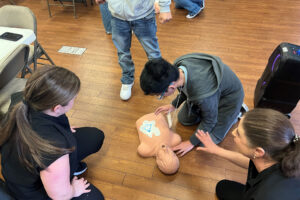
As part of an outreach program, 10 clinical nurses from Sacramento Medical Center volunteered their time and expertise to teach 25 middle school students and parents from a local school how to respond to stroke, choking, and cardiac arrest scenarios. The teaching session was designed to be engaging and interactive, focusing on three critical skills: identifying stroke symptoms with the BEFAST acronym—Balance, Eyes, Face, Arms, Speech, Time, performing a Heimlich maneuver, and Hands-Only CPR.  11.1-Clinical-Nurses-Teach-Middle-School-students

To make it more engaging, the nurse volunteers created scenarios and role-playing to simulate the signs and symptoms of the emergencies and speaking to the 911 emergency dispatcher. The participants also took turns performing Hands-on chest compression using CPR training mannequins. The participants were actively engaged in the education session and hands-on learning. Equipping the youth with the essential knowledge and skills can empower them to make a difference during critical moments 

“This experience deepened my commitment as a nurse at the bedside and to the community. It reminded me why I chose this profession—to make a difference not only at the bedside,” said Brian Teding, MS, RN, NI-BC, a clinical nurse volunteer. 

Defining Care Excellence IlyaGuryanov_Photo CROPPED

Professional development journey of multigenerational clinical nurses

Ilya Guryanov BSN, RN (pictured above)
Staff Nurse II  
KP Nurse Residency Program  

At 16, Ilya participated in the Kaiser Permanente high school internship program, which set the stage for his health care career. At 18, he was a Patient Care Technician at Sacramento Medical Center. He was accepted into the KP Nurse Residency Program in 2024 and now works as a Staff Nurse II.  

“Kaiser Permanente shaped my nursing journey, providing support, practical experience, and professional development…”  

Ace DelosSantosAce Delosantos BSN, RN, MEDSURG-BC 
Insert picture # 8 
Staff Nurse IV, 5th Floor. 
KP Nurse Scholars Scholarship Program  
 

Ace began his nursing career in 2011 working in long-term care and he joined Kaiser Permanente as a Staff Nurse II in the Medical/Telemetry unit in 2016. He is actively involved in projects, the Unit Practice Council, and the Professional Practice Committee. In 2023, he enrolled in the Samuel Merritt University MSN program through the KP Nurse Scholars Academy scholarship program, focusing on clinical leadership and education. He also serves as a preceptor, mentor for the clinical ladder, and Magnet Navigator. 

“I’m pursuing my Master of Science in Nursing Degree to deepen my understanding of the areas I’m passionate about, like evidence-based practice and specialized care. For me, furthering my education is like building my career toolkit. Nursing is not just my job but my profession. I’m invested in it.” 


Ella SilchenkoElla Silchenko ADN, RN, GERO- BC 
Staff Nurse IV, 5th Floor. 
KP Specialty Certification Voucher Program 
 

Ella started her career in health care as a Medical Assistant and then pursued nursing. In 2006, she joined Kaiser Permanente-Sacramento, where she has remained since as a Staff Nurse on the 5th Floor. In 2024, she earned her Gerontological Nursing Certification (GERO- BC™) board certification from the American Nurses Credentialing Center leveraging on a KP-sponsored Geriatric Review Course and the Nurse Scholars Academy certification voucher program.  Ella also completed the NICHE Geriatric Resource Nurse Program at Sacramento Medical Center.  

 “Pursuing my geriatric certification (GERO-BC) was an intentional step to continue growing professionally and personally. It was about enhancing my knowledge of geriatric care and becoming a stronger resource for my coworkers, especially as our patient population ages.” 


Johnhay AnchetaJohnhay Ancheta BSN, RN 
Staff Nurse II, ICU 
KP NCAL Transition to Practice Program (ICU Fellowship) 
 
Before becoming a nurse, Johnhay was a preschool and school-age teacher. He started his nursing career at Kaiser Permanente in 2011 and has been an active member of various hospital committees, earning his Staff Nurse IV.  In 2024, he joined the ICU Transition to Practice, a six-month program of combined didactic, clinical experience in the unit and skills enhancement sessions. Johnhay joined the Sacramento ICU team as a staff nurse on the night shift. 

“After spending ten years in the med-surg telemetry unit, I knew I was ready for a new challenge and to take my nursing career in a different direction. I’ve always been drawn to critical care, so when the opportunity to join the ICU fellowship program came up, I didn’t hesitate—I knew this was my chance to grow and learn. It’s an exciting step that reflects my passion for expanding my skills and taking on a role where I can make an even more significant impact.” 

7.-Could-this-be-sepsis

Could this be sepsis? 

Sepsis continues to be a one of the primary reasons of hospital readmissions from Skilled Nursing (SNF) facilities. Internal data shows that sepsis, predominantly resulting from Urinary Tract Infections (UTI), is the main cause of sepsis related admissions/readmissions from SNF to the Sacramento ED. As one of the measures to address this concern, the hospital collaborated with a SNF to create an educational initiative aimed at training SNF staff on sepsis prevention, early identification and escalation. Clinical nurses Mary Boardman, BSN, RN, CEN (ED) and Ace Delo Santos, BSN, RN, MEDSURG-BC (5th Floor); and Operating Room Assistant Nurse Manager Jennice Singh, MSN, RN, CNOR volunteered their time in developing the materials, teaching, and facilitated the breakout sessions.  

Certified Nursing Assistants (CNAs), who have the most frequent contact with residents, were taught on how to use the STOP AND WATCH acronym to recognize early infection indicators and relay concerns to the on-duty nurse. The program also highlighted how evidence-based care practices that are already part of the resident’s activities of daily living (ADLs), including oral hygiene, skincare, and bladder care, are important in preventing pneumonia, wound infections, and UTIs. Lidija Bilkic, RN, Infection Preventionist at Grammercy Court, noted, “This training empowers CNAs to deliver proactive care to our residents as they are the primary caregivers and best positioned to observe changes in resident conditions.” 

During the breakout session, the SNF nurses examined Systemic Inflammatory Response Syndrome (SIRS) criteria, analyzed case studies, and demonstrated the Situation-Background-Assessment-Recommendation (SBAR) framework for escalating changes in patient conditions. The sessions also stressed the significance of early detection and reporting of any alterations in a resident’s health status. The staff were urged to report to the nurse on duty even minor changes that might appear inconsequential for further assessment and monitoring. The interactive nature of the training allowed participants to apply the SBAR framework in case scenarios, boosting their communication abilities and assurance in escalating concerns.  

The educational sessions were attended by over 50 SNF staff members. One CNA remarked, “I appreciated the class and interactive components. The games are fun and engaging. I learned information that I can use in my work. I also like the badge buddy as a reference so I can recall the STOP AND WATCH acronym for assessing changes in resident’s condition.” 

The collaboration between hospital and skilled nursing facility (SNF) nurses highlights the importance of partnerships in improving community health and reducing preventable hospital readmissions. By combining expertise, sharing resources, and networking, institutions can strengthen their capacities in addressing health conditions such as sepsis, and promoting common goals to improve patient outcomes. 

a group of nurses smiling

A Kaiser Permanente Richmond nurse’s global pilgrimage to provide compassionate care 

In October 2024, Annabelle S. Muli, BSN, RN, a nurse at Kaiser Permanente Richmond Medical Center, exemplified the spirit of nursing excellence by participating in the St. Bernadette Supportive Care Pilgrimage in France. Over seven days, this dedicated nurse joined a global team to provide compassionate care to individuals seeking solace and healing in Lourdes, a destination known for its spiritual significance. 

Leaving from LAX, she represented Kaiser Permanente’s commitment to holistic care, bringing her skills and empathy beyond our local community to serve on an international scale. This journey reflects the heart of nursing—meeting people where they are, physically and emotionally, and making a profound difference through service. 

Her participation highlights the dedication, compassion, and excellence that define Kaiser Permanente Richmond nurses, both at home and abroad. 

Nurse hands out pink bags at breast cancer awareness event

Celebrating the Richmond community, culture, and care in 2024 

Kaiser Permanente Richmond proudly demonstrated its commitment to cultural diversity and community engagement in 2024 through a variety of events and initiatives that reflected our values of equity, inclusion, and service. From hands-on volunteering to cultural celebrations, our nurses and staff led the way in strengthening ties with the communities we serve. 

Nurse leaders at MLK Day eventOur team rolled up their sleeves for community volunteering events such as Rx in the Park, the Breast Cancer Walk, the MLK Day Tree Planting Event, and a heartwarming Christmas adoption program supporting a local homeless shelter near the hospital. These efforts highlighted our dedication to addressing community needs beyond the walls of our medical center. 

In addition, our nurses championed initiatives in diversity, equity, and inclusion, fostering culturally sensitive care and celebrating the richness of our shared humanity. Cultural events like PRIDE, Black History Month, Latin Heritage Month, and the Chinatown Street Fest brought staff and community members together, building connections and understanding. 

Kaiser Permanente Richmond’s 2024 efforts reflect the power of culturally competent care and inclusive leadership to create healthier, more connected communities in alignment with Kaiser Permanente’s mission and vision. 

Donate life flag

Honoring the gift of life 

Redwood City nurses hold a special connection with patients who become organ and tissue donors because of profound neurologic injuries. After one such experience, Carlos Martinez, RN, a graduate of the ICU Specialty training program, was moved to teach the organ donation session and became a preceptor for subsequent ICU Specialty programs.  

Through a partnership with Donor Network West, Redwood City offers an Honor Walk, where staff from all areas of the hospital are able to line the halls to honor patients and their families who make the decision to donate lifesaving organs and tissue. Witnessing the honor walk for his patient shaped his perception of nursing’s role in the transition from critically ill patient to donor.  Redwood City also offers a Donate Life flag raising ceremony to families, where hospital staff and security officers gather at the front entrance to the hospital and solemnly observe the Donate Life flag raised in honor of a donor.   


5 nurses gathered around a table

Streamlining patient discharges: A collaborative pilot program  

Angelica Fadayel, BSN, RN, 6 South Nursing Unit Council Chair, Karen Cepero, DNP, RN, NEA-BC, CCRN, CEN, Adult Services Director, and Mark Lee, BSN, RN, Manager of 6 North and 6 South, collaborated to find an innovative solution to improve the strategic goal of discharging patients by 1 PM.

Evidence supports the implementation of a dedicated discharge nurse program as an effective strategy to improve discharge efficiency. This dedicated discharge nurse works closely with care teams to streamline the discharge process, ensuring timely education, coordination, and communication with patients and families. Early results of the pilot program have highlighted improved efficiency, reduced delays, and enhanced patient satisfaction, showcasing the power of collaboration in driving organizational goals. 


4 nurses with a cart that says Maternal

Champions of change: Nurses leading the charge against maternal sepsis 

Maternal Sepsis is a leading cause of preventable maternal deaths, with 63% considered avoidable according to the California Maternal Quality Care Collaborative (CMQCC). In response, NCAL Regional leadership implemented a maternal sepsis Best Practice Alert (BPA) in February 2024 to enhance early identification and treatment. 

As there are significant nursing workflows that are integrated into this work, J’Marc Javelosa, MSN, RN, RNC-NIC, NPD Specialist, along with labor and delivery nurses, Maria Acenas, BSN, RN, RNC-OB, and Dianne Sanchez, MSN, RN, collaborated to facilitate education of the nursing staff and promote the adoption of these workflows. Maria and Dianne created an educational poster board and presented it at staff meetings, huddles, and rounded on the hospital units with a roving cart.  

Back To Top