Skip to content
Innovation featured image placeholder

Improving code blue response through role delineation in a med-surg telemetry unit

In Med-Surg Telemetry Units, the management and outcomes of a Code Blue (cardiac arrest or medical emergency) event rely, among other processes, on clear role delineation to improve communication and team dynamics. Many nursing units still operate without clear role delineation during a Code Blue response. This lack of defined roles can lead to confusion, delays in life-saving interventions, and poor patient outcomes.  

Racquel Agamata MSN, RN, PCCN, Nursing Professional Development Specialist, conducted an evidence-based practice (EBP) project to inquire on the evidence behind assigning Code Blue role delineation before the shift change, comparing it to the current practice where roles are not pre-assigned in Med-Surge Telemetry Units.  

Clinical Question 

To define the scope of literature search, the PICO question was “How does role delineation (role assignment) at the beginning of a shift affect the efficiency of Code Blue response in a Med-Surg Telemetry Unit compared to no role assignment? 

Search Strategy 

To gather relevant evidence, an organized search strategy was employed across multiple databases such as PubMed, Ovid, CINAHL, Cochrane Database using the search terms Code Blue, Role Assignment, Role Delineation, Cardiac Arrest, Efficiency in Emergency Response. Search Techniques includes Keyword, Title, MeSH Terms, Reference Mining. A total of 7 articles were reviewed, all included in the body of evidence for analysis. 

Evidence Synthesis 

The literature review consistently supports the idea that role delineation improves team efficiency during Code Blue events. The following key findings emerged from the evidence: 

  • Clarity and Efficiency: Pre-assigned roles eliminate confusion, allowing team members to act immediately without delays in task allocation. 
  • Enhanced Communication: Role delineation streamlines communication, enabling quicker decisions and more efficient interventions. 
  • Timely Interventions: Assigning roles ensures critical tasks like airway management, CPR, and medication administration are performed promptly. 
  • Improved Coordination: Clear roles improve team dynamics, maximizing skill utilization and task execution efficiency. 

Practice Recommendations 

Based on the evidence reviewed, several practice changes are recommended to improve Code Blue response efficiency: 

  1. Pre-Assigned Roles: Assign roles during shift handoff to ensure preparedness.
  2. Color-coded systems: Use visual cues for quick role identification.
  3. Staff Engagement: Involve team members in the role assignment process.
  4. Equipment Readiness: Ensure crash carts and medications are easily accessible.
  5. Ongoing Education: Train staff on role delineation and Code Blue protocols.
  6. Mock Drills: Conduct regular practice drills with post-event critiques.
  7. Feedback Loops: Gather staff input to refine the process.
19.-Switch-to-multi-use-eye-drops-reduces-costs-and-waste-without-impacting-patient-outcomes

Switch to multi-use eyedrops reduces cost and waste without impacting patient outcomes

In the September 2024 issue of the Outpatient Surgery Magazine, OR Excellence Awards Edition, the Racho Cordova- Eye Surgery Center received an Honorable Mention to recognize their impactful work.  

The Rancho Cordova Eye Surgery Center, a two-room facility specializing in cataract surgery, practice change by switching from single-use to multi-use eye drops, dramatically reducing waste and costs—all without compromising patient outcomes. 

Previously, the facility used single-use eye drop vials to dilate patients’ pupils in the preoperative area. However, only a fraction of the medication—an average of three drops per bottle—was used before the remainder was discarded. To mitigate this practice’s cost and environmental impact, leaders and staff began exploring alternatives. Unnecessary waste of perioperative eye drops inflates the cost of ophthalmic surgeries, increases the carbon footprint, and worsens periodic drug shortages. 

In June 2023, the center transitioned to multi-use vials, a move that has proven successful. Before the switch, the facility used an average of 132 single-use vials weekly. By October 2023, that number had dropped to just 47 multi-use vials per week, a reduction of 85. 

“After implementing our multi-use drops policy and evaluating data over four months, we found that bottle ordering decreased by 63% and costs decreased by 53.3%,” says Haley Murphy, BSN, RN, Assistant Nurse Manager. “Most importantly, we did not observe any significant spike in infections or complications during this period.” 

The benefits extended beyond cost savings and waste reduction. When patients must dilate their pupils at home before surgery, they often face added costs for purchasing full bottles of eye drops at the pharmacy. Additionally, arriving at the facility with dilated pupils can create safety concerns, such as difficulty reading consent forms. By using multi-use drops onsite, the center ensures patient safety while addressing the national shortage of dilation drops and reducing the large amount of plastic waste generated by single-use vials. 

“This initiative highlights the importance of nurse involvement in cost-saving decisions within health care to maintain the highest quality standards in the clinical setting,” says Murphy. She adds that the highly skilled nursing team at Rancho Cordova has been instrumental in refining this process and other innovative programs. The team’s efforts, led by nurses, benefitted the facility and served as a model for other local health care facilities seeking to implement similar strategies. 

By sharing its protocols and results with local leaders, Rancho Cordova Eye Surgery Center demonstrated how operational changes driven by frontline staff can lead to impactful, sustainable improvements in patient care and resource management. 

2025-02-20 215714CROPPED

Improving endovascular stroke treatment times for better patient outcomes 

During an ischemic stroke, every minute untreated results in the loss of 1.9 million neurons. This makes timely treatment essential, particularly for patients who qualify for Endovascular Stroke Treatment (EST), which aims to restore blood flow to the brain. A team of nurses, physicians, technicians, and other ancillary members worked together on a quality improvement project in the Sacramento Emergency Department (ED) focused on reducing the time between patient arrival and Neurointerventional Radiology (NIR) treatment by redesigning the flow and processes.  

As a Comprehensive Stroke Center, the hospital must have efficient processes and systems in place to support the needs of patients seeking advanced neurologic care due to stroke. The project’s goal was to decrease the Door-In-Door-In (DIDI) time, the interval from ED arrival to NIR, to under 65 minutes for at least 35% of qualified patients. Previously, this target was not being met, and barriers to faster treatment were identified.  

“One major adjustment we made was keeping patients in the CT suite to assess for large vessel occlusion rather than sending them back to the ED. This simple change allowed staff to remain with the patient, reducing delays and ensuring a seamless transfer to NIR,” shares Christine Swanson, BS, ADN, RN, Staff Nurse II, Emergency Department. “We also implemented direct access to the EST phone line, which significantly improved communication and speeded up report handoffs for faster patient transport.  We educated ED staff on the locations of Neuro IR supplies and streamlined workflows for both business and after-hours operations. These changes have made a meaningful impact on efficiency and patient outcomes.” The project has reduced delays and ensured more efficient care, helping to meet the <65-minute DIDI goal and faster EST times.  

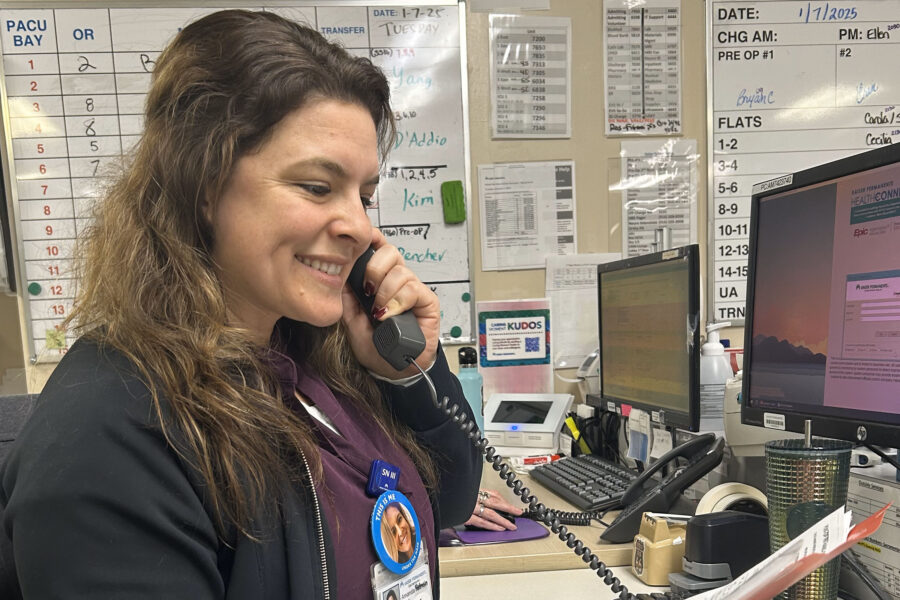
Nurse on the phone

Optimizing hospital throughput  

Hospital throughput is the movement of patients from admission to discharge, ensuring they receive timely, appropriate care at every stage of their hospital stay. An efficient throughput process affects clinical outcomes and many other aspects of care, such as care experience and cost of care, as documented in numerous studies.  

“When a patient transfer is delayed within the hospital, it creates a ripple effect. For example, a backlog in the Emergency Department (ED) leads to longer wait times for community members seeking emergency care. Delayed discharges result in fewer available beds for incoming patients. Holding patients in the Operating Room (OR) because the Post-Anesthesia Care Unit (PACU) bed is not ready can also affect the patient’s recovery from anesthesia,” explains Carri Carson, BSN, RN, Assistant Director, Sacramento Emergency Department. “Hospital throughput is a complex process requiring close collaboration across multiple departments.”   

The hospital has prioritized initiatives to optimize the throughput process. Sacramento’s throughput core team is at the forefront of leading this work. The team is composed of interdisciplinary leaders who work together to identify barriers, implement strategies, and monitor outcomes. The throughput team’s leadership has positioned the hospital as a benchmark for throughput efficiency. Dorothy Vergel MSN, RN, CCRN, Nurse Manager, Post Anesthesia Care Unit shared an example of improvement led by clinical nurses, “when we started our PACU to Floor process improvement, clinical nurses from PACU and the inpatient units collaborated that led to a streamline in the hand-off and escalation process to reduce delays in patient transfers. It did not only reduce delays but also increased staff satisfaction.” 

In 2024, key metrics have consistently outperformed regional and local benchmarks, including ED-to-Floor, OR-to-PACU, and PACU-to-Floor times. “Our success highlights the strong culture of interdisciplinary collaboration in our hospital,” says Kristin Davis, MSN, RN, House Supervisor. “My role in coordinating bed placement relies on the efficient work of every team member—clinical nurses, physicians, pharmacy staff, lab personnel, bed control staff, house supervisors, Patient Care Coordinators, nurse leaders, transport, and housekeeping. Everyone contributes to the process, and our results reflect that teamwork.”   

Key Throughput Achievements in 2024:   

  • ED to Floor: The percentage of patients admitted in less than 60 minutes rose from 9% in 2023 to 32% in 2024. The average time patients spent waiting to be moved to a hospital room was 178 minutes in 2023. In 2024, this average wait time decreased to 110 minutes, representing a 38% reduction. 
  • OR to PACU: Achieved less than 15 minutes from “time zero,” with only three total holds in 2024, (total of 25 minutes).  
  • PACU to Floor: Reduced the time from inpatient order release to bed placement by 45% compared to 2023, moving closer to the goal of 60 minutes.  

Nurses have been instrumental in optimizing workflows and ensuring efficient systems. Tim Hutchinson, MSN, RN, Hospital Operations Director, underscores this impact: “The leadership and advocacy of clinical nurses at the bedside is helping drive these processes efficiently while keeping our patients safe.” By leveraging their expertise and collaboration, nurses continue to lead meaningful change that enhances patient care and strengthens operational excellence. 

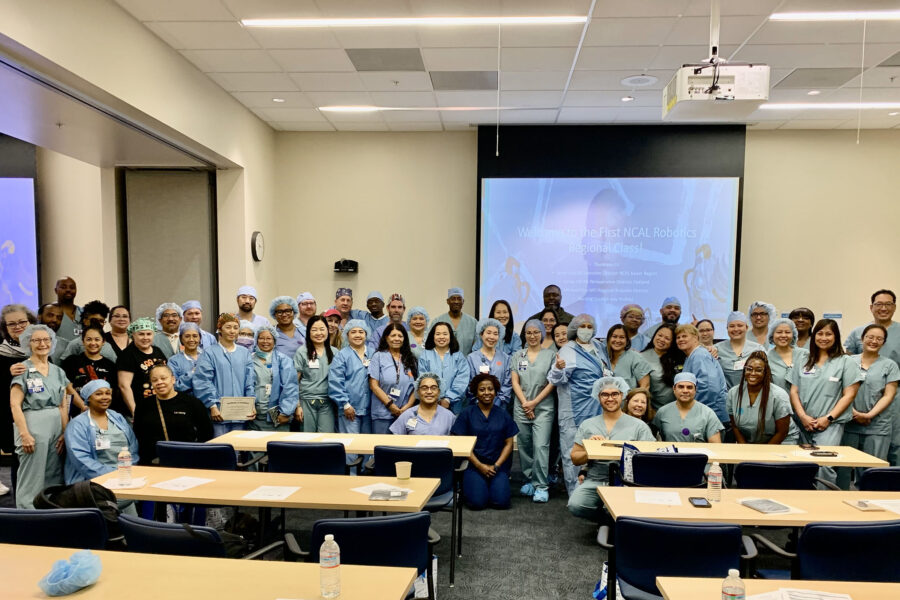
large group of nurses in a conference room

Nurse‑led program enhances skills for robotic surgery

Kaiser Permanente Northern California (NCAL) is at the forefront of surgical innovation, with nurses and surgical technologists (STs) playing a pivotal role in advancing robotic surgery, which offers benefits for patients, including smaller incisions, reduced pain, and faster recovery times.

“This advanced technology requires highly skilled perioperative staff to ensure optimal outcomes,” said Jenny Mendenhall, MSN, RN, CHSE, CNOR, NCAL lead perioperative consultant. “Partnering with industry leaders, we developed a comprehensive training program that focuses on theoretical knowledge and hands‑on experience.”

In June, Mimi Nguyen, RN, Nursing Professional Development Practitioner at Kaiser Permanente San Francisco, piloted the first robotic “Train the Trainer” Kaiser Permanente NCAL training event.

The “Train the Trainer” program empowers experienced nurses and STs to become educators in their respective departments,” said Nguyen.

By equipping these nurses and STs with advanced robotic skills and teaching methodologies, Kaiser Permanente NCAL aims to create a sustainable pipeline of qualified robotic team members.

Another initiative is the regional robotic surgery program which provides hands‑on instruction and simulation to nurses, STs, and Sterile Processing Technicians (SPDs). The staff rotate through robotic stations to learn about the patient’s experience, the surgeon’s perspective, and troubleshooting the robot.

Ruth Leong, RN, who works at the Modesto Medical Center participated in the regionwide training, and said “I now have more knowledge, and am better equipped to answer questions from patients and their families about their robot‑assisted surgeries.”

“By investing in the professional development of our nursing and perioperative workforce, we are ensuring that our patients receive the highest quality care, delivered by highly skilled and knowledgeable clinicians,” said Mendenhall.

Innovation featured image placeholder

Nursing-related technology innovations    

Jovie Jabla, MSN, RN, CCRN, VA-BC, acting as interim nursing professional development specialist, implemented mobile vital signs and B-Braun technology to improve accuracy in documentation, eliminate inefficiencies, and improve medication safety. 

Innovation featured image placeholder

Nurses involved in innovating care spaces in Richmond’s emergency department 

Faced with the constant challenge of an overflowing emergency department, Kaiser Permanente Richmond’s emergency nurses took the lead in redesigning workflows to maximize space and efficiency. Initially, the team creatively repurposed the nearby mammography waiting room, transforming it into an extension of the emergency department to see and treat patients quickly. 

Building on this innovation, the nurses also collaborated to implement a mobile unit for rapid care, offering a more efficient and patient-centered solution compared to the previous use of emergency tents in the yard in front of the hospital. This forward-thinking approach improved patient flow, reduced wait times, and ensured patients received timely care—all while maintaining the high standards of quality and safety that define Kaiser Permanente Richmond. 

large group of nurses at a conference

Kaiser Permanente Richmond nurses shine at the Magnet® Conference 2024 

Kaiser Permanente Richmond nurses swapped trick-or-treating for transformative learning as they joined over 14,000 nursing professionals in New Orleans for the 2024 Magnet Conference. The team attended impactful sessions, networked with industry leaders, and brought back fresh ideas to elevate patient care. 

Kaiser Permanente’s senior nursing leadership proudly sponsored a breakfast event, underscoring their dedication to nursing excellence. Later in the conference, Richmond’s Magnet Director Kimberly A. Lewis, PhD, RN, captivated an audience of approximately 400 attendees with her presentation on mentorship and belonging among new and experienced nurse leaders. Her research offered innovative insights into fostering connection and sparked meaningful dialogue about supporting leadership growth in nursing. 

The conference was a testament to Kaiser Permanente’s leadership in advancing nursing practice and our nurses’ commitment to continuous improvement—both on and off the unit. 

3 nurses with a sign

Advancing nurse excellence through research and evidence-based practice 

Jovie Jabla, MSN, RN, CCRN, VA-BC, exemplifies a commitment to nursing research and evidence-based practice. From leading innovative projects like the creation of a vascular access team and ultrasound guided IV training to publishing on patient safety and mentorship, Jovie’s work empowers nurses, improves outcomes, and strengthens Kaiser Richmond’s culture of excellence. 

Kimberly A. Lewis, PhD, RN, Magnet® Program Director at Richmond, presented her research about nurse leader mentorship, grit, and organizational belonging to an audience of over 400 nurses at the Magnet Conference. 


a group of nurses at a graduation

Nurse-led research and EBP initiatives

Research Studies 

  • Facilitators and participants from the KP Cares Cohort 1 Graduation with KP-SJO, KP-SCL and KP-RWC.  
  • Kaiser Permanente Caring Attributes of Resilience to stress (KP-CARES 2.0). Perla Baldugo, MSN, RN, NPD-BC, Sandra Vargas, BSN, RN, CPLC 
  • The Clinic: An 8 Hour Resiliency Educational Workshop centered on Jean Watson’s Caring Science Theory. Perla Baldugo, MSN, RN, NPD-BC, Sandra Vargas, BSN, RN, CPLC 
  • Prospective QoL Study for Ethnic Stroke Patients. Sheryn Shahwan-Solorzano, PhD (c), MSN, RN, CPHQ 

2024 Evidenced Based Practice Initiatives: 

  • Cue-based feeding in Neonates. Britney Scanlon, RN, EBP Fellow 
  • Hyperthermia in Neonates. Joanne Leslie, MSN, RN, EBP Immersive Experience Participant 
  • Preceptors and Novice Nurses. Latresa Stewart, MSN, RN, EBP Immersive Experience Participant 
  • HAPI Reduction in the ICU. Christopher Clark Ylanan, MSN, RN, EBP Immersive Experience Participant 
  • Strategies That Leverage Transformational Leadership To Enhance Nurse Leader Retention Effectively. Jennifer Encinas, RN, EBP Immersive Experience 

Podium Presentations: 

Improving Door to EKG Times. Donna Blevins, RN & Tanya Kostuchek-Ward, BSN, RN, CEN. KP Nurse Scholars Academy Research & Innovation Academy CoP. 

Poster Presentations: 

  • Door-to-EKG Performance Improvement Project. Sheila J. Rowe, MSN, RN, CEN, Donna Blevins, RN. KP National Nursing Conference.  
  • Implementation of a standardized handoff tool for patients transferring into the Neurologic ICU. Kathryn M. Snow, DNP, RN, MS, SCRN, CNRN, Clinical Nurse Specialist. KP National Nursing Conference. 
  • Pediatric Asthma Improvement Project. Sheila Rowe, MSN, RN, CEN, Christina Fowlks, MSN, RN. KP National Nursing Conference.  
  • Perspectives Across a Health System: The Role of Clinical Nurse Specialists in Implementing and Sustaining a Delirium Prevention and Early Intervention Program. Colette Jappy, DNP, RN, ACCNS-AG, Philip Garcia, MS, RN, AGCNS-BC, PCCN,  Joria Rainbolt-Clemente, DNP, CNS, GERO-BC, Annette Tuatagaloa, MSN, RN, CNS,  Dianne Sorrera, MS, RN, AGCNS-BC, AMSRN, PCCN Alexandra Fogli, MSN, RN, CNS, AGCNS-BC, Christa Perryman, MS, RN, CNS, AGCNS-BC, Krystal Pombo, MSN, RN, CNS, AGCNS-BC,  Mary Salas, MSN, RN, CNS, AGCNS-BC, Teresa Buhagiar, MS, RN, GCNS-BC, ACHPN, CEN. KP National Nursing Conference. 
Back To Top