Skip to content
4 nurses smiling

Advancing Evidence-Based Practice across our nursing teams

In 2024, our nursing team made significant strides in advancing evidence-based practice (EBP) through targeted professional development initiatives. Two of our dedicated OR nurses, Miranda Wyatt, RN, CNOR, and Lucile Pinlac, BSN, RN, participated in the EBP Immersive Experience, a rigorous hybrid training program designed to deepen knowledge and skills in implementing evidence-based changes. Over three in-person immersion days, virtual workshops, and coaching sessions, they developed impactful practice change proposals tailored to enhance patient safety in the operating room. Wyatt focused on strategies to reduce surgical site infections (SSIs) by addressing traffic control, while Lucile explored interventions to prevent surgical burns. Upon completing the program, they disseminated their findings and evidence-based strategies to their OR teams, fostering collaboration and enhancing patient outcomes. Their dedication exemplifies our commitment to cultivating a professional culture rooted in evidence-based care. 

Complementing these efforts, four of our nursing leaders Michelle Mcilwain, MSN, MBA, RN, APRN, FNP-BC, NEA-BC, Doanh Ly, NDP, RN, APRN-CNS, CCRN, SCRN, Philip Garcia, MSN, RN, AGCNS-BC, PCCN, and Juan Ibanez, MSN, RN, NPD-BC, CNOR, successfully completed the EBP Mentor Training Program, positioning them as invaluable resources within our organization. This comprehensive three-day workshop series provided them with advanced EBP knowledge and the mentoring skills to guide and support clinical staff in implementing evidence-based changes at the microsystem level. The program covered critical topics such as organizational change, overcoming barriers to EBP, and applying theoretical frameworks, preparing these leaders to drive sustainable practice improvements. Their role as EBP mentors is instrumental in empowering teams to navigate complex care challenges, develop robust implementation plans, and achieve measurable outcomes. 

These initiatives highlight our hospital’s ongoing dedication to professional growth and innovation. By equipping nurses and leaders with the tools and expertise to champion evidence-based practice, we are enhancing patient care and ensuring a collaborative and forward-thinking environment where excellence thrives. These efforts solidify our leadership position in delivering high-quality, evidence-driven healthcare. 

Nurses at the launch event for CRRT.

Advancing critical care: Launching Continuous Renal Replacement Therapy and TeleCritical Care in the ICU  

In 2024, our Intensive Care Unit (ICU) achieved a significant milestone by launching two innovative programs—Continuous Renal Replacement Therapy (CRRT) and a Telecritical (TCC) Care Program. These initiatives enhanced the care provided to critically ill patients, offering advanced treatment options and expanding access to expert critical care support. The introduction of CRRT, a specialized dialysis treatment for patients with acute kidney injury, has empowered ICU nurses to deliver life-saving therapy with precision and flexibility, ensuring the best possible outcomes for patients experiencing severe renal complications. 

The TCC Program has revolutionized how we approach critical care by connecting our ICU with a network of remote critical care specialists. This program enables real-time virtual consultations, providing nurses and physicians immediate access to expert guidance for managing complex cases. During overnight shifts, TCC ensures our team can deliver consistent, high-quality care around the clock. This program’s integration has improved clinical decision-making and strengthened collaboration within our interdisciplinary teams. 

These dual advancements reflect our ICU’s commitment to leveraging technology and expertise to meet the evolving needs of our patients. The successful implementation of both programs was made possible by the dedication and leadership of Nurse Manager Baby Lyn Abadilla, MSN, MBA, RN, and Critical Care Clinical Nurse Specialist Doanh Ly, NDP, RN, APRN-CNS, CCRN, SCRN. Their efforts in training staff, standardizing workflows, and championing patient safety have been instrumental in the programs’ success. Together, CRRT and TCC have positioned our ICU to deliver cutting-edge care, ensuring our most vulnerable patients receive the support they need to recover and thrive. 

2 nurses at a display for wound care

Leveraging technology to improve patient outcomes

In 2024, our nursing team embraced innovative technology by integrating the Epic Rover App into daily workflows for documenting skin conditions and wounds. This initiative, spearheaded by nurses Zabrina Fong, RN, BSN, CWON, and Sherie Domingo, BSN, RN, and Wound and Ostomy Clinical Nurse Specialist (CNS) Jan Parks, RN, CNS, CWCN, COCN, empowers nurses to capture clear, standardized photos directly linked to the patient’s electronic health record (EHR).

By ensuring accurate, real-time documentation of wounds, nurses can better track skin integrity, enabling timely interventions and promoting collaborative decision-making among care teams. This proactive approach is instrumental in preventing complications such as hospital-acquired pressure injuries (HAPIs).

By seamlessly adopting the Epic Rover App, our nurses have enhanced consistency and precision in wound care practices, directly improving patient safety and outcomes. The app’s integration has standardized documentation processes, strengthened interdisciplinary communication, and reinforced nurses’ role as critical observers of skin health. These efforts, championed by our dedicated clinical nurses and CNS leaders, demonstrate our commitment to leveraging technology to optimize care quality and achieve better results for our patients.

Nurses at the RIA Conference

Nurses present at Research and Innovation Academy Conference

San Rafael Medical Center nurses had three poster presentations on topics such from our NICHE committee, mindfulness, and HAPI prevention at the 2024 Kaiser Permanente Northern California Research and Innovation Academy Conference. 

Each team used evidence-based practice to improve outcomes. In addition, this two-day conference was filled with fantastic sessions on how to publish, leveraging data, conducting a research study, and increasing knowledge on EBP.  Don’t miss out on this wonderful opportunity to attend one of the two days at next year’s conference. 


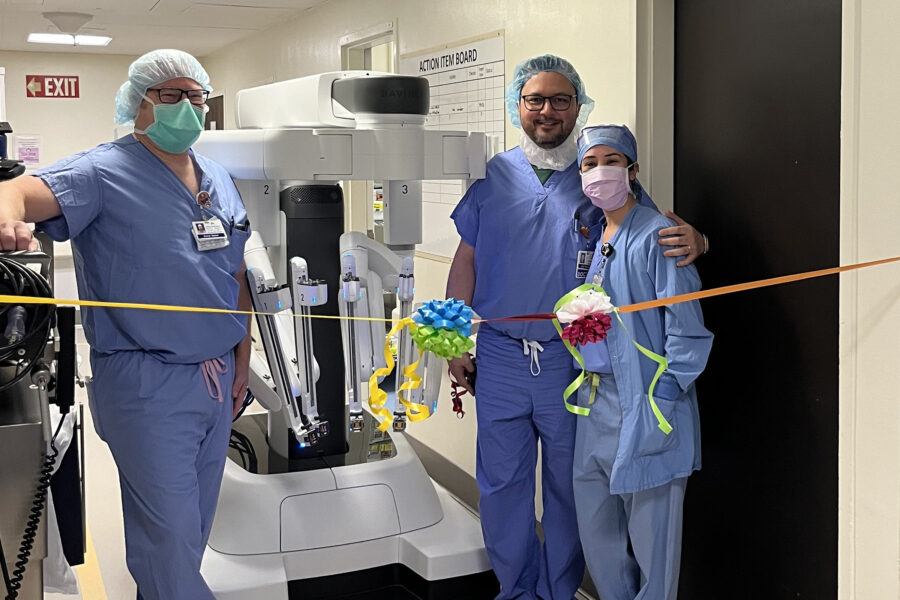
Ribbon cutting for robotics program

New robotics program comes to San Rafael

After attending a robotics workshop in September, the perioperative team began preparing for the launch of the new robotics program in San Rafael. 

Clinical nurse Daniel Domer, BSN, RN, was selected as the robotics service line coordinator in October. Daniel collaborated with colleagues across the region and brought back evidence-based best practices to He then partnered with the local perioperative team to build them for various procedures and specialties for our San Rafael Medical Center surgeons.

The interprofessional team worked seamlessly, with great collaboration and teamwork for a successful program launch. October 3rd, Claude (our robot) finally arrived in the operating room. Staff members completed their modules on the second and third week of October in preparation for the hands-on training by an Intuitive trainer. Staff members were divided into groups to ensure the training included every staff member across all shifts. 

On November 7, 2024, there was a successful launch of the program with the first cases. 

Building this robotics program allows our Marin County patients to receive patient centric, innovative, and cutting-edge robotics procedures close to home instead of having to travel outside of the service area. More than 55 cases have been successfully completed by mid-December 2024. The collaborative efforts of the surgical team and detailed planning have contributed substantially to success, setting a strong foundation for continued growth and innovation.   

The ribbon cutting ceremony for Robotics program pictured above includes Daniel Domer, BSN, RN, robotics coordinator; Dr. Jose Gomez, general surgeon, APIC surgical services; and Jeannette, Surgical Technician. 

(Re) Brilliancy Study helps with compassion fatigue, burnout and trauma

The daily work of bedside nursing care is stressful, and stressors have increased dramatically since the pandemic. Well documented literature points to compassion fatigue, burnout and secondary trauma causing many nurses to leave the profession. Nurses are not recognizing their value and are losing their ability to make authentic connections with patients and peers.

The (Re) Brilliancy study is to assess whether the 8-hour (Re) Brilliancy workshop centered on Dr. Jean Watson’s Caring Science theory provides an authentic connection by increasing compassion, satisfaction and self-compassion in bedside nurses and nurse leaders. This study investigates whether there will be a decrease in burnout and secondary traumatic stress in this population group. 


Nurse with a young patient

Championing pediatric safety: Uncovering the hidden clannges of emergency department triage

In a pivotal study, San Rafael Emergency Department (ED) leaders Tina J. Vitale McDowell, MSN, RN, CPEN, PECC, and Dana Sax, MD, have brought to light critical insights into the accuracy of triaging pediatric patients in the ED. Their research, published in JAMA Pediatrics, reveals a troubling trend: nearly 60% of pediatric ED visits are over triaged, and 7% are under triaged, leading to significant consequences for patient safety, throughput, and the quality of care. Through their collaborative efforts, Vitale-McDowell and Sax are championing improvements in pediatric care that are essential for protecting our young patients. 

 “This work is vital to support pediatric readiness and care in our EDs,” said Vitale-McDowell. “It underscores our ethical responsibility to improve pediatric triage and ensure the safety of our most vulnerable population.”

A collaborative effort is now underway involving Regional Quality, Maternal Child Health, Pediatric Emergency Medicine, and the Division of Research to further examine the impacts of mis triage. To understand the challenges faced during triage, front-line staff from all 21 NCAL ED facilities are providing their insights.

“Emergency department triage is inherently a very challenging job. Triage nurses are asked to make triage assignments with limited time to take a history or review a chart, while simultaneously managing a busy waiting room and acting as the liaison between the waiting room and the back of the ED,” explained Sax. “We are learning more about how triage is currently done, how it impacts patient outcomes and ED operations, and we can better support our front-line triage nurses in this difficult but critically important task of sorting patients on ED arrival.”

The focus ahead will be on refining triage processes to better safeguard patient safety and reduce health care disparities. The insights gained from these initiatives are instrumental in supporting our triage nurses, enhancing the care we provide to pediatric patients.

“This collaborative work is paving the way for more accurate and equitable care in our emergency departments, ensuring that every child receives the attention they need when they need it most,” said Vitale-McDowell. 

CaringScience event

Nurses participate in Caring Science Series 

Two cohorts of San Rafael clinical nurses and healthcare professionals participated in the Caring Science Series led by Caritas Coaches Lori Aston-Dixon, MSN, RN; Sarah Montague, BSN, RN; Angelica Rincon, MSN, RN, NEA-BC, CNOR; and Gail Sims, DNP, RN, CRRN, Heart Math Instructor. 

KP Cares 2.0 

Kimberly Shankel, MSN, RN, CNL, Co-PI and Chief Nurse Executive Denise Laws, DNP, RN, NE-BC, Caritas Coach and Faculty led San Rafael’s KP Cares 2.0 research study. 

15 Nurse leaders participated in a four-module series enhancing our culture of caring, beginning January 30 through April 12, 2024.  14 participants graduated from the series. 

KP Cares 2.0 is a multi-site regional qualitative research study that expands on the KP Cares 1.0 study by adding experiential learning content related to equity, inclusion, and diversity (EID) and associated evaluation instruments.

The aims of this mixed methods prospective study are to 1) evaluate effectiveness of providing an experiential education program based on Dr. Jean Watson’s Human Caring Theory and the Ten Caritas Processes and Belong at KP pre-compared to post- and repeated measures at 6 months; 2) explore if and how participants applied the principles of Caring Science, HeartMath and EID into their professional and personal lives and the associated impact 1) at the end of the program and 2) 6 months post program. 


Innovation featured image placeholder

Inquiry: What is the evidence behind CHG bathing to reduce CLABSI? 

Central-associated Blood Stream Infection (CLABSI) is one of the nurse-sensitive outcomes that is problem-prone in the hospital’s Intensive Care Unit (ICU). Patients with the central lines are bathed daily using 2 % chlorhexidine gluconate (CHG)-impregnated wipes, a component of the current practice bundle to prevent CLABSI, which has been proven to reduce the bioburden on the patient’s skin and thereby reduces the risk of central line site infection. 

As part of an ongoing quality improvement initiative to address CLABSI in the ICU, the Evidence-Based Practice (EBP) Council, a clinical nurse-led structure at Kaiser Permanente Sacramento Medical Center, evaluated the evidence behind this practice. The council’s goal was to assess whether daily bathing with 2% CHG wipes, is still supported by the latest evidence. 

To guide the clinical inquiry, the following PICOT question was formulated: In adult ICU patients with central lines (P), how does daily bathing using 2% CHG wipes (I), compared to standard soap-and-water bathing or no CHG bathing (C), reduce CLABSI rates? 

Using the PICOT question, a literature review was conducted using PubMed, CINAHL, and Cochrane Library to identify studies matching the search criteria. The literature search yielded four studies- one systematic review and three randomized controlled trials—focused on 2% CHG wipes. A study using 4% CHG wipes was not included because of its higher concentration. After a literature search, studies were appraised using the Johns Hopkins EBP appraisal tool.  

Following the appraisal and synthesis, the evidence suggests that daily CHG bathing reduces CLABSI rates compared to soap and water bathing. The findings support the current practice of daily CHG bathing of patients with central lines as part of the CLABSI prevention bundle, a set of interventions targeting various potential causes of CLABSI. Franco Balitaan, MSN, RN, CPAN, Chair of the EBP Council, shared: “EBP is not solely about adopting new interventions but also about questioning current practices within the context of a rapidly changing world of medicine and health care. The EBP Council members learned a lot taking on this topic as our first EBP clinical inquiry project.” 

Back To Top