Skip to content
Nurses with No Pass Zone signage

7N implements No Pass Zone 

In response to a high number of falls on their unit, the 7N nursing team implemented a “No Pass Zone” initiative in April 2024 to improve responses to call lights by all staff on the unit. Education, huddle messages and visual management strategies were used to increase awareness to all staff on the unit about never passing a patient’s call light without responding. Total patient falls per 1,000 patient days has been decreasing since implementation of this new practice.  

Pictured above: Joann Corgile, PCT and Jacob Zannou, MS, BS, RN

Nurses celebrating

Celebrating Zero CAUTI & CLABSI

In January 2024, the 6 N unit celebrated 1500 CAUTI-free days and 1000 CLABSI-free days. Efforts from the unit practice council around education and training contributed to these amazing patient outcomes. Nurses on 6N practice the highest standards of nursing care by adherence to the nurse driven-protocol to remove indwelling urinary catheters and maintaining high standards of ongoing infection prevention practices.  

Pictured above: Tommie R. Braden, MHA, BN, RN, 6N Manager; Sheron Blair, RN; Grace Karanja, RN; Larra Francisco, PCC; Archie Irvin; and Junhan Peng, RN.


hallway of the Oakland Medical Center

Implementing Code Fall 

Starting in January 2024, implementation of a “Code Fall” was started to improve the immediate dissemination of learnings after a fall incident. The unit leadership team initiates a post-fall debriefing session with participation from staff, patient and family members. Since this initiative, the number of falls with injury has been trending down.  


Nurses smiling with Olympic themed background

Winter Quality Olympics 

The 10 N Unit Practice Council created the “Winter Quality Olympics” to address the increase in patient harm events during the winter season. From January – March 2024, the UPC empowered their Quality Champions to lead specific educational efforts to reduce each nurse sensitive indicators.  These interventions included increasing awareness through newsletters, email, shift huddle, staff meetings and individual training sessions. Inter-professional team members were also included in the Olympics project. Comparing the same Winter timeframe between 2023 and 2024, the team reduced all harm events by 75%.  

Pictured above: Christopher Ng, BSN, RN, Staff Nurse III; Ehime Agbonkonkon, MSN, RN, Assistant Nurse Manager; Rose Kamau, BSN, RN, Assistant Nurse Manager; Susan Kearney, MSN, RN, Staff Nurse III; Shiela Escobar, MSN, RN, 10N Manager and Matris Usen, RN

nurses in an elevator with a cart

Antioch nurses surpass EPIC Acuity Validation goal

The EPIC Acuity Validation is a big event every year and this year our AMC nurses’ participation far exceeded the regional goal of achieving 1,500 validations. Together we collected over 2,023 validations this year. This is more than double the 908 collected the prior year! The team effort of our Acuity managers, our nurse managers, our Assistant Nurse Managers, EPIC Liaisons, and front-line nurses was monumental! Awards went out to 2MT PM shift with the most validations completed, followed by 2MT days, MBU days, and NICU PM shift! This is a prime example of what happens when we come together as a team to achieve a single goal.  

Picture above: Amy Danelon, MSN, RN, GERO-BC, 2MT and Heather Newton-Go, RN, MBU. 

Nurses during a training session

Enhancing quality of care for older adults

Geriatric Emergency Department Initiative (GED) team has been working to enhance the quality of care for older adults in the Emergency Department by addressing their unique medical, psychological, and social needs. ED staff learned about delirium assessment (bCAM), Timed Up & Go (TUG) testing, and patient rounding. As a result of this amazing work in the ED, the Antioch Medical Center received the American College of Emergency Physicians Geriatric Emergency Department Accreditation Level II.

Pictured above from left to right: Robert Anderson, BSN, RN, CEN; Megan Adams, BSN, RN, CEN; Alexandria Beltram, ED Technician; Erin Ortega, BSN, RN

Achievement featured image placeholder

Surgical care of geriatric patients recognized

Kaiser Permanente Antioch Medical Center successfully completed a Geriatric Surgery Verification survey from the American College of Surgeons.

Geriatric Surgical Nurse Champions promoted evidence-based practices in caring for older surgical patients, educated their peers on these best practices, led quality improvements efforts, and engaged in professional development and ongoing education related to the care of older surgical patients. They have helped improve completion rates of delirium screening with the Confusion Assessment Method (CAM) and completion of the sleep assessment.  

Jocelyn-for-delirium-rounds

Geriatric Resource Committee

The Geriatric Resource Committee (GRC) is a hospital-wide, multi-disciplinary, nursing-led forum focused on the care of older adult care. Key leaders and participants are Geriatric Resource Nurses (GRNs) who have completed a comprehensive module series on the health span of older adults. GRNs support important initiatives aimed at the care of older adults including the hospital’s Geriatric Surgery Verification and Age-Friendly care, the new CMS measure. In 2024, the GRC focused on supporting bedside nurses in delirium assessment accuracy. The GRNs led a delirium awareness roving fair and supported the Confusion Assessment Method Tournament. These initiatives engaged over 200 health care providers.

Another significant accomplishment was the expansion of GRN-led delirium rounds, which involve identifying high-risk patients, conducting bedside assessments and chart reviews, and collaborating with primary nurses and physicians to provide recommendations. All with an aim to prevent delirium. Positive outcomes have included reduced patient tethering, improved sleep-wake cycles, and increased mobility. Committee participation has also contributed to nurses achieving ladder promotion and board certification. Congratulations, Jocelyn Manalo and Shiobee Paningbatan! The GRC is facilitated by Colette Jappy, RN Geriatric Clinical Nurse Specialist.

  • Charmel Cabildo, BSN, SN II, Med Surg Tele, 1 North
  • Jillian Guglielmo, BSN, SN II, Med Surg Tele, 1 North
  • Tiffany Jiang, BSN, SN II, Med Surg, 3 Center
  • Aeran Cho, PhD, SN II, Med Surg, 4 Center
  • Shiobee Paningbatan, BSN, CMSRN, SN III, Med Surg Tele, 5CE,
  • Junia Bote, BSN, SN IV, Med Surg Tele, Cardiac Procedure Unit/5Ce
  • Jeffrey Silao, SN II, Med Surg Tele, 6 South
  • Jocelyn Manalo, BSN, MEDSURG-BC, SN IV, Med Surg Tele, 1 North
  • Deborah Quinto Capistrano, BSN, SCRN, SN IV, Med Surg Tele, 7CE
  • Donald Taracido, ADN, SN II, Med Surg Tele, 7 South
  • Eric Witkowski, BS, ADN, CCRN, SN II, CVICU
  • Monica Tsai, BSN, PCCN, SN II, ICU
Goal milestone featured image placeholder

Critical Care implementation of SSKIN Bundle

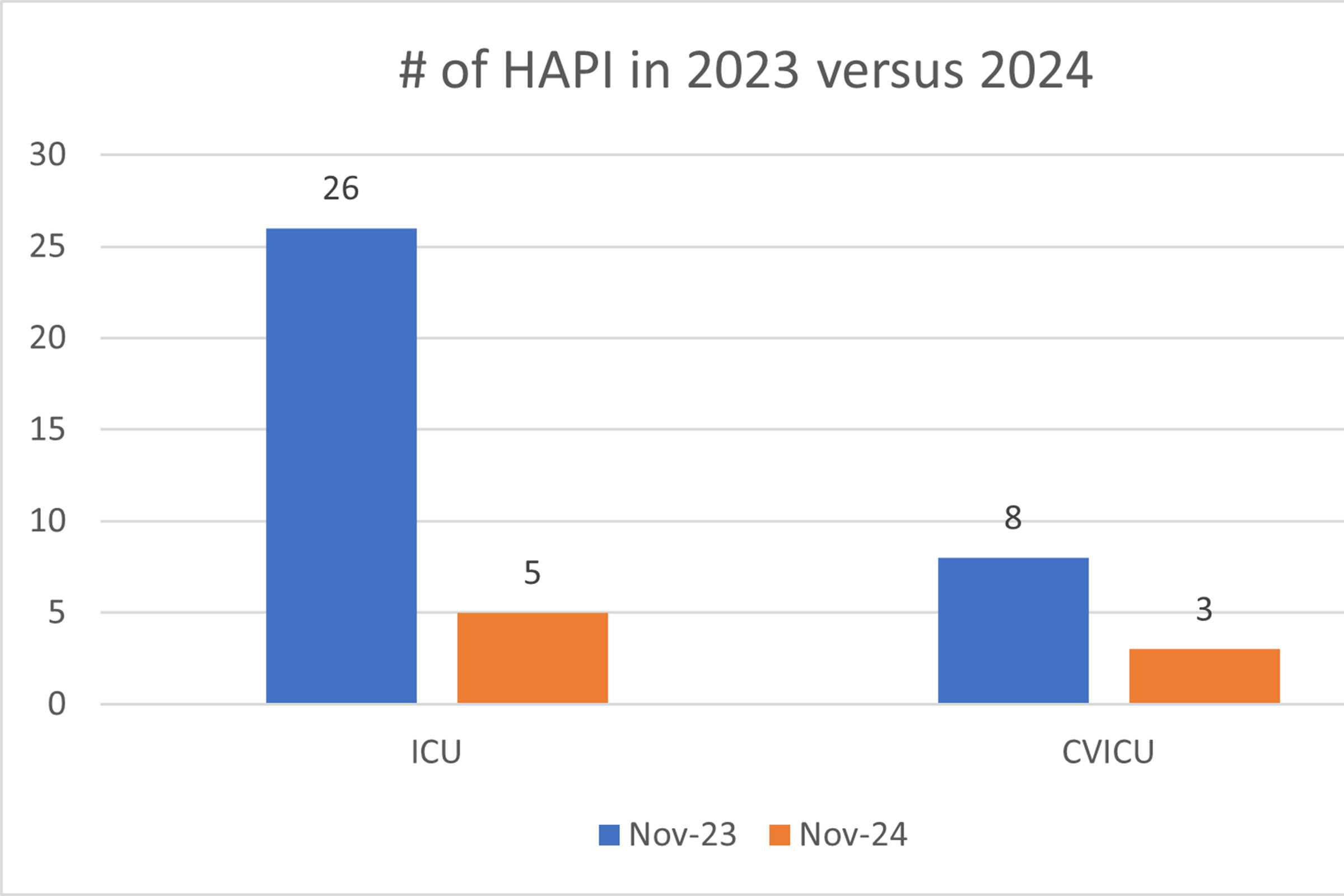
Hospital-Acquired Pressure Injuries (HAPIs) are a significant concern, particularly in critical care departments where patients are often less mobile and at higher risk due to disease processes. In 2023, KP SFO was leading NCAL region for highest HAPI Rates. In November 2023, 40% of KP SFO HAPI were from Critical Care Units (ICU: 29.8% and CVICU: 10%). Reducing HAPIs is directly aligned with the department’s goal of improving patient outcomes, increasing patient safety, and reducing the hospital’s overall health care costs associated with pressure injuries. The adult critical care department, led by Liz Ramirez, BSN, CCRN, SN IV, implemented targeted strategies with goal of reducing department HAPI incidences by 30% for 2024 while enhancing early identification and treatment of high-risk patients by:

  • Providing staff education on HAPI prevention SSKKIN bundle.
  • Implementing “4eyes in 4hrs” 2RN skin assessment.
  • Changing CVICU/ICU patient 2RN skin assessment minimum frequency to daily.
  • Utilizing advanced technologies (.CCSKIN smartphrase).

#-of-HAPI-2023-v-2024 graph

LC-skills-day-1

Breastfeeding collaborative increases Exclusive Chest feeding rates by 10%

The breastfeeding collaborative was a committee established this year. It includes a multidisciplinary team approach with MD, NPs, staff from the clinic and RNs within the hospital. There are RNs that participate from labor and delivery, postpartum and NICU. They work to improve the communication and education between the clinic and the hospital setting. This team also worked to put on two skills days, one in the spring and one in the fall, to support and empower the RNs with their lactation skills and the RNs with the DHM program. This team also collaborates with quality to review data each month so we can better understand where we are doing well, and where there are opportunities for improvement. This year they have worked to increase our exclusive breastfeeding results from 59% to 69 %!

Back To Top