Skip to content
Working group of nurses

Reducing hospital-acquired pressure injury through shared governance and collaboration

In 2024, the Nursing Quality and Safety Council demonstrated the power of shared governance by tackling hospital-acquired pressure injuries (HAPIs) with an innovative and collaborative approach. Council members Analyn Altamira, BSN, RN, Becky Nguyen, RN, Huixian Tan, BSN, RN, Joy Apostol, RN, Maria Cleofe Cruz, BSN, RN, Pamela Nufable, BSN, RN, Pauline Uy, BSN, RN, and Sherie Domingo, BSN, RN, led the effort to introduce the EHOB Position Perfect Covered Wedges across the hospital. These specialized devices help maintain patients in a lateral side-lying position, ensuring proper sacral offloading to prevent pressure injuries and come in various sizes to meet diverse patient needs. 

The council’s collaboration ensured a thorough evaluation of the wedges’ effectiveness, a well-planned rollout, and comprehensive education for staff to integrate this tool into daily workflows. Their efforts highlight the importance of shared governance, where nurses take an active role in decision-making and driving initiatives to improve patient outcomes. This initiative not only reduced HAPIs but reinforced a culture of teamwork, innovation, and accountability, showcasing the significant impact of empowered nursing leadership on patient safety and quality care. 

Nurse with a chair

Enhancing fall prevention in the ICU through collaboration and technology

In late 2023, ICU nurses and leadership collaborated to address patient fall rates by assessing current practices and identifying gaps in fall prevention strategies. The team determined that the absence of chair and bed alarms for high-risk patients was a critical issue, particularly given changes in sedation practices and a focus on early mobilization. After evaluating potential solutions, they selected the STANLEY Healthcare Fall Management System, specifically the M200 Fall Monitors, which provides staff wireless, real-time alerts, enabling timely interventions. This collaborative process highlighted the value of shared decision-making in adopting innovative strategies to improve patient safety. 

The deployment of the fall monitors in January 2024 marked a significant advancement in fall prevention efforts within the ICU. Nurses took the lead in integrating the new technology, offering education, hands-on training, and reminders during pre-shift huddles to ensure consistent use. This initiative resulted in a measurable decrease in patient fall rates, showcasing the power of teamwork and technology in enhancing outcomes. The ICU’s prioritizing collaboration and innovation reaffirmed its commitment to delivering safe, high-quality patient care. 

3 nurses smiling

Advancing patient safety through standardized nursing education

In 2024, the Nursing Professional Development (NPD) Team achieved a significant milestone in patient safety by standardizing education for clinical nurses across Medical-Surgical and Telemetry units. Led by Pamela Pilotin, MSN, RN, CPHQ, CNS, Jessica Panlasigui, BSN, RN, and Ronelle Winch, BSN, RN, (pictured above), the team launched a mandatory two-day Nursing Professional Development (NPD) Day. This initiative directly addressed insights from the Clinical Nurses’ Learning Needs Assessment and the increased falls with injury rate at the start of the year. The curriculum included assessing fall risks, implementing evidence-based interventions, and using technological tools to enhance prevention efforts, ensuring nurses had the knowledge and skills to improve patient safety. 

As a result of this standardized education, the Medical-Surgical and Medical-Telemetry units saw a measurable decrease in falls with injury rates per 1,000 patient days. By aligning with SSF’s 2024-2026 Nursing Strategic Plan, this initiative enhanced clinical competencies and demonstrated the power of standardized professional development in driving meaningful quality improvements.  

RWC-03a-OO_PDD-Group-Photo

Redwood City nurses soar to new heights in their practice

Kaiser Permanente nurses demonstrated their commitment to creating and sustaining a culture of excellence by advancing their professional practice through earning advanced degrees, moving to the next level of the clinical ladder, obtaining national board certification, and graduating from the nurse residency program.

Over 90 nurses attended the nursing professional development day, hosted by the Professional Development Core Council. The event featured four local universities, highlighted the DAISY and PETAL award programs, provided insights into the Career Ladder program, and shared information on obtaining specialty certification to support nurses professional growth.

Nursing degrees earned

Amanda Mann, MBA, MSN, RN, CMSRN
Assistant Nurse Manager, Med/Surg/Telemetry

Kathryn Snow, DNP, RN, MS, SCRN, CNRN
Clinical Nurse Specialist

Nurse Residency graduates

Shirley Chen, MSN, RN
Bethlehem Gebremariam, BSN, RN
Yanyan Xu, BSN, RN
Sara Otaru, BSN, RN

Joe Solar, MSN, RN
Matina Kayastha, BSN, RN
Tsering Sherpa, RN

Board certifications

Hsiu (Maggie) Chuang, BSN, RN, CAPA, CPAN
Staff Nurse III, PACU

Amanda Mann, MBA, MSN, RN, CMSRN
Assistant Nurse Manager, Med/Surg/Telemetry

Lydia Radonic, BSN, RN, GERO-BC
Staff Nurse II, Med/Surg 

Sherri Twardzik, MSN, RN, NEA-BC, CCRN, EBP-C
Magnet Program Director, PCS

Lisa Xu, BSN, RN, CPAN
Staff Nurse III, PACU 

Career Ladder advancements

Clinical Nurse 4

Marie Gerrodette, RN
Staff Nurse IV, Procedure Center

Joanne Leslie, MSN, RN, RNC-NIC
Staff Nurse IV, Special Care Nursery

Janelle Mingming Ferrer, BSN, RN
Staff Nurse IV, Labor & Delivery

Rupinder Sidhu, RN
Staff Nurse IV, Procedure Center

Clinical Nurse 3

Hsiu (Maggie) Chuang, BSN, RN, CAPA, CPAN
Staff Nurse III, PACU

Amanda Mann, MBA, MSN, RN, CMSRN
Assistant Nurse Manager, Med/Surg/Telemetry

Lydia Radonic, BSN, RN, GERO-BC
Staff Nurse II, Med/Surg

Sherri Twardzik, MSN, RN, NEA-BC, CCRN, EBP-C
Magnet Program Director, PCS

Lisa Xu, BSN, RN, CPAN
Staff Nurse III, PACU

Career Ladder Advancements
Staff Nurse III

Yaxian Bao, BSN, RN
Staff Nurse III, Interventional Services

Julie Beckley, BSN, RN
Staff Nurse III, ICU

Rosita Berroya, BSN, RN
Staff Nurse III, Patient Care Coordinator

Raymond Bodestyne, BSN, RN
Staff Nurse III, Procedure Center

Allison Buenaventura, BSN, RN, CNOR
Staff Nurse III, Main Operating Room

Ma. Teresita Castro, BSN, RN
Staff Nurse III, Emergency Department

Maricela Fragoso, BSN, RN
Staff Nurse III, ICU

Kimberly Gorospe-Dedner, BSN, RN
Staff Nurse III, PACU

Selene Gorrell, RN
Staff Nurse III, Labor & Delivery

Hazel Juinio, RN
Staff Nurse III, Emergency Department

Yonghong Ke, MS, BSN, RN, CWON
Staff Nurse III, Wound Care

Shirley Lau, RN
Staff Nurse III, Labor & Delivery

Racquel Lauron, BSN, RN
Staff Nurse III, PACU

Josephine Layo, BSN, RN, CCRN
Staff Nurse III, PACU

Elizabeth Legaspi, BSN, RN
Staff Nurse III, ICU

Tamara Linne, RN
Staff Nurse III, Special Care Nursery

Krystal Macaulay, BSN, RN
Staff Nurse III, Labor & Delivery

Grace Malasan, BSN, RN
Staff Nurse III, ICU

Ian Mopas, BSN, RN
Staff Nurse III, Patient Care Coordinator

Lisa Xu, BSN, RN, CPAN
Staff Nurse III, PACU

Dawn Yep, BSN, RN
Staff Nurse III, PACU

Specialty Training Program Graduates

Perioperative Training Program

Sabrina Alvarez, BSN, RN
Staff Nurse II, NOU

Steven Chow, BSN, RN
Staff Nurse II, OR

Richard Quinonez, RN
Staff Nurse II, OR

Michael Tam, BSN, RN
Staff Nurse II, OR

Caritas Coach Education Program (CCEP) Graduates

Amanda Sayaseng, BSN, RN
Staff Nurse IV, Labor & Delivery

Nasim Karmali, RPh
Clinical Director, Quality Services

Evidence-Based Practice (EBP) Training Programs

Foundations of EBP

Hsiu (Maggie) Chuang, BSN, RN, CAPA, CPAN
Staff Nurse III, PACU

Johanna Dulay, BSN, RN
Staff Nurse II, Med-Tele

Christina Fowlks, MSN, RN
RN Educator, Emergency Department

Maricela Fragoso, BSN, RN
Staff Nurse III, ICU

J’Marc Javelosa, MSN, RN, RNC-NIC
NPD Specialist, Special Care Nursery

Jessica Lam, BSN, RN
Staff Nurse II, Med-Tele

Racquel Lauron, RN
Staff Nurse III, PACU

Latresa Stewart, MSN, RN
NPD Specialist, Perioperative

Lynn Utecht, MAN, RN, CNL
Quality Nurse Consultant

Noel Zeng, BSN, RN
Staff Nurse II, 6N Med-Tele

EBP Immersive

Latresa Stewart, MSN, RN
NPD Specialist, Perioperative

Joanne Leslie, MSN, RN, RNC-NIC
Staff Nurse IV, Special Care Nursery

Christopher Clark Ylanan, MSN, RN
Staff Nurse II, ICU

EBP Fellowship Program

Jennifer Encinas, RN
Assistant Nurse Manager, MCH

Britney Scanlon, RN, IBCLC
Staff Nurse IV, Special Care Nursery

EBP Mentor Training Workshop

Carolyn Leonard, MSN, RN, CNS, RNC-OB, C-ONQS
Clinical Nurse Specialist, Labor & Delivery

Christa Perryman, MS, APRN-CNS, AGCNS-BC
Geriatric Clinical Nurse Specialist

Sherri Twardzik, MSN, RN, NEA-BC, CCRN, EBP-C
Magnet Program Director

Leading a Culture of EBP

Karen Cepero, DNP, RN, NEA-BC, CCRN, CEN
Interim Chief Nurse Executive

Perla Baldugo, MSN, RN, NPD-BC
Nursing Professional Development Director

Leadership Training Programs

Academy for Interdisciplinary Leadership

Yvette Acosta-Coleman, MSN/HCA, RN
Nursing Operations Director, Patient Care Services

Sherri Twardzik, MSN, RN, NEA-BC, CCRN, EBP-C
Magnet Program Director, Patient Care Services

Leading Caring in Healing Environments

Amanda Sayaseng, BSN, RN
Staff Nurse IV, Labor & Delivery

Maricela Fragoso, BSN, RN
Staff Nurse III, ICU

Middle Management Institute

Mark Lee, BSN, RN
Nurse Manager, Med/Surg/Telemetry

Ashley Morris, MSN, RN, RNC-OB, C-EFM
Nurse Manager, Maternal Child Health

Nurses in the OR

Reduction in surgical site infections, perioperative services

In May 2024, the new perioperative leader team partnered with quality and created an interprofessional team to review surgical site infections and opportunities for improvement. Through great teamwork and collaboration, a multiprong approach was established and a comprehensive bundle was established. 

Clinical nurses from the SSI committee reviewed literature, current AORN Guidelines and revised their site-specific skin preps in the operating room with training and return demonstrations. Perioperative nurses reviewed evidence-based practices for preoperative hair clipping and CHG wipe application and applied those skills to practice. 

The interdisciplinary team also developed an OR cleaning grid, educated on instrument point of use care and transportation policy, implemented ATP testing after cleaning operating rooms.  Perioperative medicine, the total joint coordinator and preoperative nurses successfully implemented mupirocin decolonization protocol for targeted surgical cases.  In addition, the committee partnered with Home Health, HBS, ED, and adult family medicine providers to refer surgical site concerns back to the surgeon for management. 

Together, these practice changes have contributed to an overall reduction in surgical site infections over the past five months.  Baseline data is 2.02 offs ratio and post implementation, the rate has reduced to 1.49 odds ratio. 

Group of nurses at a celebration

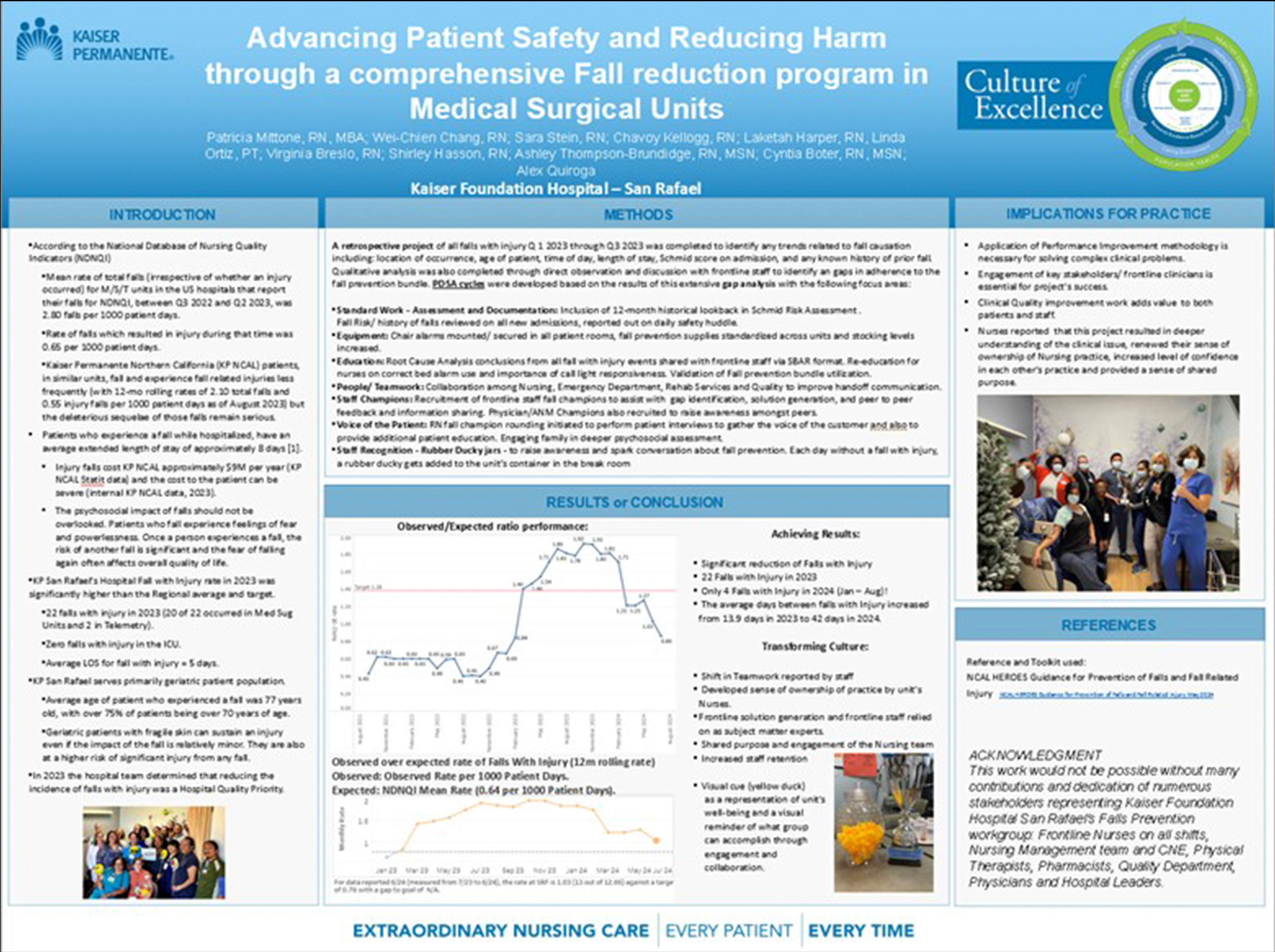
Team works to reduce falls with Injury 

Falls with Injury observed/expected ratio peaked in October 2023 at 1.92. The falls committee, made up of interdisciplinary team members, participated in a gap analysis to identify gaps in adherence to the fall prevention bundle. 

PDSA cycles were then developed based on what was identified in the gap analysis. Key focus areas were standard work for fall risk/history of falls reviewed on all new admissions and reported out at the daily safety huddle.

Chair alarms were mounted in all patient rooms, fall prevention supplies standardized across units with an increase in par levels. 

Findings from the root cause analysis from all falls with injury events were shared with the clinical nurses via SBAR format.  Education was provided on the correct bed alarm use and the importance of call light responsiveness.  Collaboration between inpatient nursing, emergency department, rehab services, and quality to improve handoff communication between teams. 

The clinical nurse champions rounded on patients and environment, conducting patient interviews and education, identified any opportunities, created solutions, provided peer to peer feedback and knowledge sharing.  To raise awareness and visibility of progress of the falls work, rubber duckies were added to the jar in the breakroom each day the unit went without a fall with injury.  This improvement project has assisted with transforming culture, increasing teamwork, ownership of practice by the clinical nurses on each unit, empowerment of clinical nurses to get involved and create change, and increased staff retention. 

The incredible falls work has been sustained and current data through September 2024 has the falls with injury observed/expected rate at 0.94.  The 5th floor team has just celebrated 365 without a fall with injury on their unit.   

The work was led by: Patricia Mittone MBA, BSN; Wei-Chien Chang, BSN, RN; Sara Stein, BSN, RN; Chavoy Kellogg, BSN, RN; Key Harper, BSN, RN; Linda Ortiz, PT; Virginia Breslo, RN; Shirley Hasson, BSN, RN; Ashley Thompson-Brundidge, MSN, RN; Cyntia Boter MSN, RN; and Alex Quiroga. 

25.-A-multipronged-response-to-lagging-survey-scores

A multipronged response to lagging survey scores  

In early 2023, Kaiser Permanente Sacramento Ambulatory Surgery Center (ASC) faced significant challenges in patient satisfaction, ranking 27th out of 29 Kaiser facilities with a care experience score of 71.6%, well below the group average of 79.9%. Identifying issues with discharge instructions, the unit’s Care Experience Committee, a clinical nurse led group, and the leadership team revised their process and workflow in providing discharge instructions, which earned the center the 2024 Outpatient Surgery Magazine OR Excellence Award for Patient Satisfaction and Experience. 

The ASC team found in their gap analysis from patient feedback that unclear recovery instructions and the absence of family members during discharge teaching contributed to low patient satisfaction scores. Patients often struggled to retain or process information while recovering from anesthesia. Not only does this impact patient satisfaction, but it can also negatively affect patient compliance and safety during recovery. In response, the center implemented a quality improvement plan, including: 

  • Delivering recovery instructions pre-operatively before sedation. 
  • Using “recovery” instead of “discharge” to clarify expectations. 
  • Enhancing materials with bold “Recovery and Home Care Instructions” labels. 

The initiative also emphasized staff training in patient-centered care, caring moments, and nurse-patient communication strategies and launched recognition programs to reward and promote excellence in patient-centric care.  

By January 2024, the care experience top box score rose to 86.9%, a 15% increase, surpassing the original 10% improvement goal. Scores continued climbing, reaching a record 92.5% in February 2024. “We’re proud of the progress, but our mission to improve never ends,” said Erica Osborne, BSN, RN, Nurse Manager. “Providing the best possible care experience remains our top priority.” 

(Excerpts from Outpatient Surgery Magazine)  

2 nurses talking at the bedside

Increasing registered nurse-to-patient communication  

Effective communication between nurses and patients is essential in improving patient outcomes by building trust, enhancing adherence to treatment plans, and increasing patient satisfaction. It also helps prevent medical errors, promotes patient autonomy, fulfills nurses’ legal and ethical obligations to keep patients well informed, and ensures continuity of care across different health care settings. 

In the last quarter of 2023, before the intervention, the unit’s HCAHPS top box-composite score on nurse communication was 77.1% on 4 East and 87% on 4 West. To further improve the patient experience, the 4th Floor Care Experience Committee, a nurse-led group under the Unit Practice Council at Kaiser Permanente Sacramento Medical Center, has implemented initiatives to improve RN-to-patient communication by focusing on inconsistent RN-to-patient communication related to explaining the plan of care and progression towards discharge.  

The team used the Kamishibai card system to provide a structured and standardized 10-step process for conducting a Nurse Knowledge Exchange (NKE) at the bedside, including an explanation of the care plan and discharge. To reinforce the practice, the NKE Nurse Leader Validation was also implemented as a process observation to ensure that NKE consistently practiced at the bedside. 

Post-intervention data indicates a shift and improvement in the nurse communication composite’s satisfaction scores of 78.6% on 4 East and 90.9% on 4 West. Staff feedback also indicates improving practice ownership, confidence in the process, and team dynamics. “We are seeing the positive impact of this initiative on both our patients and our team,” said Vanessa Stammler, BSN, RN, Staff Nurse II, 4th floor Care Experience Committee lead. “Patients feel more informed and connected to their care, and our staff has embraced the importance of clear, consistent communication.” 

Nurse at an IV pump

Reducing CLABSI in the ICU: A staff nurse-led quality improvement initiative 

Hospital-acquired infections (HAIs) such as Central Line-Associated Bloodstream Infections (CLABSI) remain a critical concern, particularly in the Intensive Care Unit (ICU), where up to 48% of patients require central lines for treatment delivery and are vulnerable for infections due to underlying conditions and invasive procedures. Central Line-Associated Bloodstream Infections are linked to negative patient outcomes, including high morbidity, mortality, and substantial health care costs.  

A quality improvement initiative led by the ICU Unit Practice Council- Quality Committee addressed the increasing incidence of CLABSI observed in unit-level trended data. From 2023 continuing to 2024, the initiative focused on identifying practice gaps and implementing measures to reduce CLABSI occurrences. Surveys and clinical audits revealed key issues such as non-adherence to dressing change procedures, inconsistent knowledge among staff regarding the CLABSI bundle, and inadequate auditing processes. 

The Quality Committee team provided in-depth, one-on-one peer-to-peer education sessions to over 90% of ICU RNs to address these gaps, enhancing their central line management and care competency. The education also included CLABSI bundle components, proper dressing changes, and blood sampling techniques. As a result of the ongoing gap analysis, the team also introduced practice changes such as replacing the piggyback bags every 24 hours, using port-less IV tubing to minimize contamination, and using pre-installed leur-lock and manifold for multiple drips to avoid manual assembly. Additionally, the frequency of audits was increased to twice daily. 

The ongoing quality improvement initiatives have led to a notable sustained reduction in the CLABSI incidence in the unit. Though fluctuations in data have been observed, the overall trend shows positive progress, with staff continuing to adapt and improve practices. This staff nurse-led initiative has improved CLABSI and enhanced patient safety in the ICU through ongoing education and peer-to-peer feedback. 

Nurse with a young patient

Championing pediatric safety: Uncovering the hidden challenges of ED triage

In a pivotal study, San Rafael Emergency Department (ED) leaders Tina J. Vitale‑ McDowell, MSN, RN, CPEN, PECC, and Dana Sax, MD, have brought to light critical insights into the accuracy of triaging pediatric patients in the ED.

Their research, published in JAMA Pediatrics, reveals a troubling trend: nearly 60% of pediatric ED visits are overtriaged, and 7% are undertriaged, leading to significant consequences for patient safety, throughput, and the quality of care. Through their collaborative efforts, Vitale‑McDowell and Sax are championing improvements in pediatric care that are essential for protecting our young patients.

“This work is vital to support pediatric readiness and care in our EDs,” said Vitale‑McDowell. “It underscores our ethical responsibility to improve pediatric triage and ensure the safety of our most vulnerable population.”

A collaborative effort is now underway involving Regional Quality, Maternal Child Health, Pediatric Emergency Medicine, and the Division of Research to further examine the impacts of mistriage.

To understand the challenges faced during triage, front‑line staff from all 21 NCAL ED facilities are providing their insights.

“Emergency department triage is inherently a very challenging job. Triage nurses are asked to make triage assignments with limited time to take a history or review a chart, while simultaneously managing a busy waiting room and acting as the liaison between the waiting room and the back of the ED,” explained Sax. “We are learning more about how triage is currently done, how it impacts patient outcomes and ED operations, and we can better support our front‑line triage nurses in this difficult but critically important task of sorting patients on ED arrival.”

The focus ahead will be on refining triage processes to better safeguard patient safety and reduce health care disparities. The insights gained from these initiatives are instrumental in supporting our triage nurses, enhancing the care we provide to pediatric patients.

“This collaborative work is paving the way for more accurate and equitable care in our emergency departments, ensuring that every child receives the attention they need when they need it most,” said Vitale‑McDowell.

Back To Top