Skip to content
Gathering Inn 1

Nurse leaders volunteer to prepare food for the hungry at the Gathering Inn

As part of Kaiser Permanente’s 20th anniversary of commitment to Dr. Martin Luther King Jr.’s vision through volunteerism, the Roseville Medical Center team partnered with The Gathering Inn to serve dinner at its Auburn shelter from January 16 to February 16, 2024.

For 30 days, different leadership groups took turns preparing and serving hot meals to 160 guests each evening. The meals, including gumbo, spaghetti with garlic bread, and pizzas, provided warmth and nourishment to those experiencing homelessness. This service not only made a meaningful impact on the guests but also provided a powerful opportunity for the leaders to give back to their community, embodying Dr. King’s message of service, compassion, and unity.

Air-Tap

ICU reduces hospital-acquired pressure injuries

In 2023, nearly half of Kaiser Roseville’s 36 Hospital Acquired Pressure Injuries (HAPIs) were attributed to the Intensive Care Unit (ICU). To address this challenge, the ICU initiated a nurse driven pilot of the AirTap system in July 2023.

The AirTap is an innovative patient repositioning system that uses air-assisted technology to reduce the physical effort required to move patients. This system helps prevent pressure injuries by offloading pressure points, minimizing friction and shear, and managing moisture during patient repositioning. Before the system was adopted and implemented in October 2023, the majority of ICU staff received training on the new technology, with Safe Patient Handling classes incorporating AirTap. Since the system’s introduction, positioning related pressure injuries have decreased by 81% in the ICU, marking a successful step toward improving patient safety and care outcomes.

Heated-&-humidified-gases

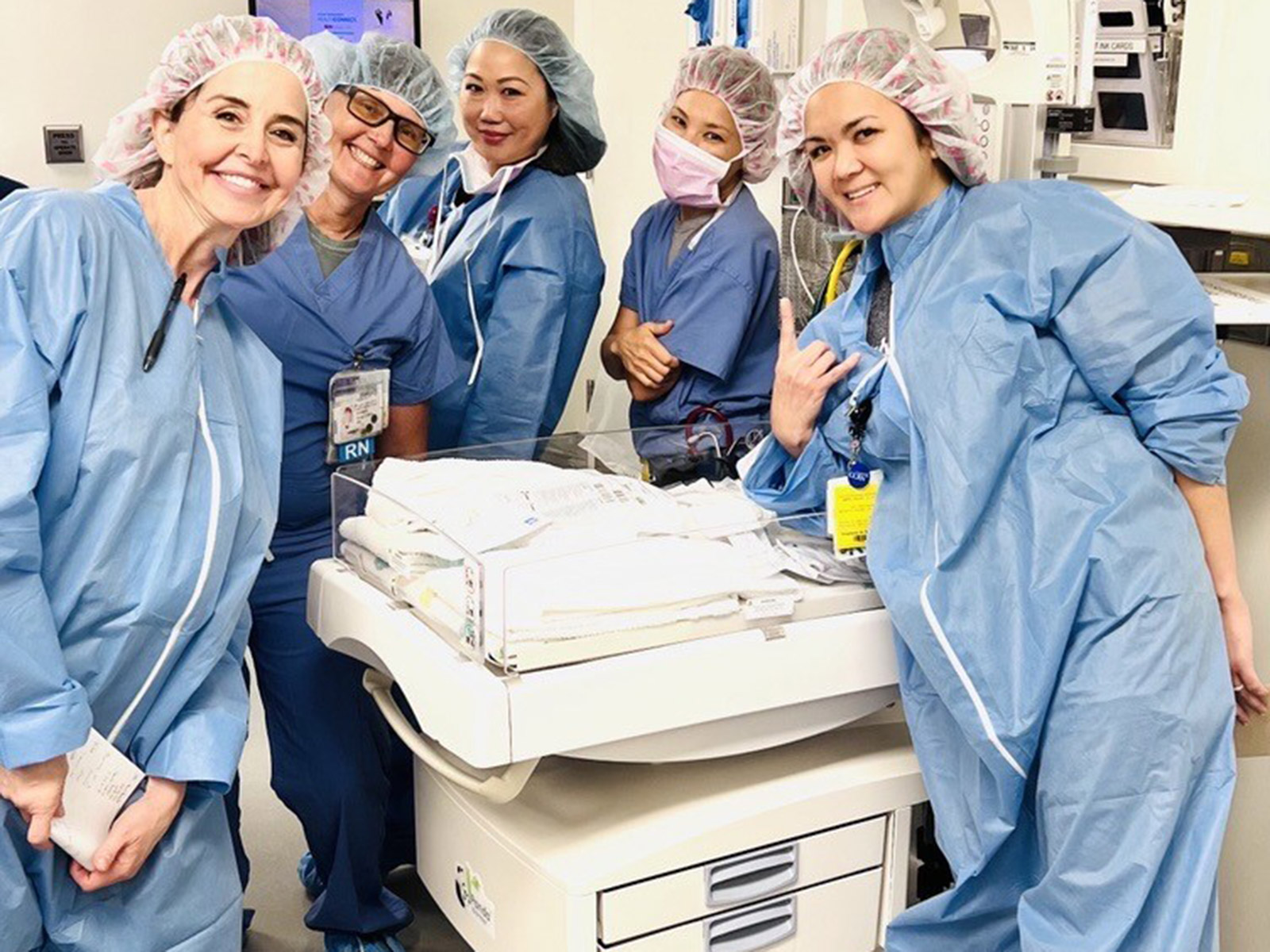
NICU implements heated and humidified gases for thermoregulation

Maintaining normothermia in very low birth weight (VLBW) infants during their initial hours in the Neonatal Intensive Care Unit (NICU) is crucial to preventing long-term health complications.

In 2023, despite best efforts with preheated incubators, thermal mattresses, and polyethylene wraps, over 30% of VLBW babies arrived at the NICU with abnormal temperatures. To address this, NICU nurse Carrie Capansky, BSN, RN, and the Newborn Delivery Attendance Committee launched an initiative in July 2023 to provide heated and humidified gases during resuscitation and transfer to the NICU for babies under 32 weeks gestation or weighing less than 1500 grams. Education on this new approach was provided to neonatologists, registered nurses, and respiratory therapists. Since the implementation of this protocol in January 2024, only 2 VLBW infants have arrived hypothermic in the NICU, significantly improving patient outcomes and promoting better thermoregulation from the moment of birth.

a keyboard and stethiscope

Informatics Council enhances patient armbands for improved care

In 2023, the Informatics Council at Kaiser Permanente Roseville raised concerns about the challenges posed by patient armbands featuring only a single QR code, which made scanning difficult if a patient was lying flat or if the armband was too tight to reposition. In response, Chief Nurse Executive Debbie Reitter, DNP, MSN, RN, CNS, NEA-BC escalated the issue to regional partners. By Summer 2024, the Informatics team collaborated with the region to design and implement enhanced armbands. The new armbands feature larger medical record numbers (MRNs), a second MRN, 13 QR codes for improved scanning, a second ID barcode, and spaces for a patient’s preferred name and gender pronouns. Registered Nurses on the Informatics Council provided valuable real-time feedback, resulting in further modifications to the prototype. In October 2024, the upgraded armbands were officially rolled out across the Kaiser Roseville campus. The addition of multiple QR codes ensures more efficient scanning, regardless of a patient’s position, while the inclusion of preferred names and gender pronouns has led to increased patient satisfaction. Plans are in place to extend the enhanced armbands to other Kaiser sites across Northern California in the near future.

LMA

NICU implements latest neonatal resuscitation guidelines

In September 2024, the Kaiser Roseville Women and Children’s Hospital became one of the first in the nation to implement the updated 2023 NRP guidelines from the American Heart Association and American Academy of Pediatrics regarding the use of supraglottic airways during neonatal resuscitation. Led by Stephanie De Ocampo, MSN, RN, CCRN, and Carrie Ann Capansky, BSN, RN, the multidisciplinary Newborn Delivery Attendance Committee’s Supraglottic Airway subgroup developed a clinical decision support tool to assist the NICU Resuscitation Team in selecting infants for positive pressure ventilation using a supraglottic airway instead of a face mask. The NICU Delivery Team provided comprehensive education and simulation training on the new guideline, including hands-on practice with supraglottic airways for physicians and nearly 100 NICU registered nurses and respiratory therapists. All neonatal sizes of supraglottic airways were stocked in every neonatal crash cart on campus, and supraglottic airway kits were placed next to all newborn resuscitation warmers in Labor and Delivery, including the OR spaces. Since implementation, 57 babies at this medical center have safely received positive pressure ventilation via supraglottic airway, marking a significant advancement in neonatal care.

PAC-RN-team
Innovation featured image placeholder

Nurse-led research enhances evidence-based practice knowledge and competencies

In January 2024, following Institutional Review Board approval, Kaiser Permanente Roseville launched a nurse-led research study to assess the organization’s evidence-based culture and readiness, and to evaluate the effects of an evidence-based practice (EBP) immersion on EBP knowledge and competencies among registered nurses (RNs) participating in hospital-level professional governance councils, regardless of their prior EBP experience.

The study aimed to increase EBP knowledge and competency among participants in these councils, locally known as the Voice of Nursing (VON). The EBP immersion program included 2 hours of EBP instruction, combining didactic and workshop activities, during monthly VON days over a 6-month period. Validated pre- and post-surveys were administered. Results demonstrated a significant increase in EBP competency and a large effect on EBP knowledge. Participants in VON generally perceived an improvement in Kaiser Roseville’s organizational culture and readiness for EBP after the immersion, further advancing the hospital’s commitment to fostering a culture of evidence-based care. 

Smoke Free OR

Smoke-free operating room to protect staff health

In response to the health risks posed by surgical smoke, which contains toxic chemicals, viruses, and bacteria, the Kaiser Roseville Operating Room (OR) has taken proactive steps to safeguard the well-being of its staff.

Nurses outside smiling by a tree

Workplace Violence Program achieves key successes

Kaiser Roseville’s Workplace Violence Program (WPV), led by Thuy Ho, RN, Tera Mitts, RN, Renee Stalker, RN, and Natalie Rommel, RN, has made significant strides in improving safety for staff through increased utilization of the Threat Management Response Team (TMRT).

Formed in 2016, the TMRT provides guidance for staff on how to access resources when dealing with threatening or intimidating behaviors. The goal of the WPV Program was to reduce Code Gray calls by increasing TMRT engagement. To support this initiative, the WPV team developed a comprehensive 4-hour training course covering TMRT procedures, the difference between Code TMRT and Code Gray, workplace violence regulations, reporting, and documentation. Approved by nursing leadership in March 2024, the training launched in April and has successfully trained nearly 600 RNs by the end of 2024. This education has led to a reduction in Code Gray calls and an increase in TMRT usage. Additionally, physical contact workplace injuries have significantly decreased, with 39 reported in 2024 compared to 49 in 2023. The WPV Program is committed to continuing this important training to further enhance the safety and well-being of all staff at Kaiser Roseville.

NICU reunion 2

NICU reunion brings joyful celebration

Kaiser Permanente Roseville Medical Center hosted a heartwarming reunion in Fall 2024, welcoming back 300 families whose babies had spent their early days in the neonatal intensive care unit (NICU) in 2020 and 2021.

This was the first NICU reunion since 2018, following a hiatus due to the pandemic. For many parents, their NICU experience was a challenging and emotional time, but the reunion offered a joyful opportunity to celebrate their children’s health and growth. Nurses, physicians, and staff who played a vital role in the babies’ early care were thrilled to reconnect with families. The event featured fun activities for the NICU graduates and their siblings, including games, face painting, bounce houses, and even a pumpkin patch in the medical center courtyard. The success of the event was made possible by over 100 dedicated volunteers, ensuring a memorable day of celebration and community for our littlest members.

Age-Friendly-Designation

Roseville Medical Center milestone in age-friendly care

Kaiser Roseville has long recognized the unique needs of its aging population, with approximately 60% of its adult patients aged 65 and older. In 2020, the hospital launched the NICHE (Nurses Improving Care for Healthsystems Elders) program to enhance care for older adults. Nurses were also encouraged to become Geriatric Resource Nurses (GRNs), who, through specialized training, address geriatric syndromes such as depression, delirium, malnutrition, frailty, falls, and pressure injuries.

In November 2023, Kaiser Permanente Roseville Medical Center was honored as a Level 1 Age-Friendly Health System Participant by the Institute for Healthcare Improvement (IHI), a recognition driven by the GRNs after attending the NICHE conference earlier that year. This achievement validated the integration of the 4Ms framework—what matters most, mentation, medication, and mobility—into the care of older adults. Building on this success, in July 2024, the hospital reached the highest level of Age-Friendly Health System recognition, Committed to Care Excellence, further cementing its commitment to delivering exceptional care to its aging population.

Back To Top